



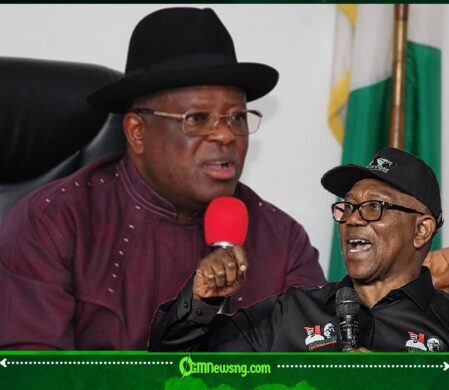
Recent political exchanges between the Minister of Works, David Umahi, and former Anambra State Governor, Peter Obi, have triggered renewed national debate over leadership integrity, political communication, and the growing intensity of Nigeria’s pre-2027 election atmosphere. The controversy follows Umahi’s strong comments suggesting that no politician can attain the presidency through deception, a statement widely interpreted as a direct criticism of Peter Obi.
The remarks have since spread across political circles and social media platforms, deepening existing divisions between supporters of both figures. While Umahi’s position was framed as a defence of governance standards and infrastructure achievements under the current administration, critics argue that such statements risk escalating political hostility ahead of the next election cycle.
Political Exchange Over Leadership and Accountability
David Umahi, serving as Minister of Works, recently defended President Bola Tinubu’s infrastructure agenda while questioning narratives surrounding opposition candidates, including Peter Obi. He emphasized that leadership must be rooted in verifiable achievements, arguing that public trust cannot be built on rhetoric alone.
Umahi’s comments were made during a public inspection of federal road projects, where he reiterated that Nigeria’s development requires continuity in infrastructure delivery. He also challenged opposition supporters to compare governance records across past administrations, insisting that performance should remain the standard for evaluating political leadership.
In response, Peter Obi has consistently maintained in public statements that Nigeria’s progress depends on strengthening institutions, reducing waste, and improving accountability in governance. His supporters argue that his political message focuses more on system reform than personality politics, a contrast that continues to fuel debate.
Growing Political Tensions Ahead of 2027 Elections
Analysts say the exchange between both political figures reflects a broader pattern of heightened political rhetoric as Nigeria moves closer to the 2027 general elections. The rivalry between supporters of the ruling political establishment and opposition figures like Peter Obi has become increasingly visible across traditional and digital media platforms.
Observers note that while political criticism is normal in democratic systems, the tone of recent exchanges signals a more polarized environment. Issues such as infrastructure development, governance credibility, and regional political alignment are becoming central themes in public discourse, often amplified by partisan interpretations.
Civil society commentators have also called for restraint, urging political leaders to focus on issue-based engagement rather than personal attacks. They warn that escalating rhetoric could distract from critical national challenges such as inflation, insecurity, and unemployment. The ongoing political exchange involving David Umahi and Peter Obi reflects the intensifying competition for public influence in Nigeria’s evolving democratic space. As the political landscape continues to shift, attention is likely to remain fixed on how leaders balance criticism with responsibility, and whether issue-based governance can prevail over personality-driven narratives in the months ahead.
Table of Contents
Discover more from OGM News NG
Subscribe to get the latest posts sent to your email.