









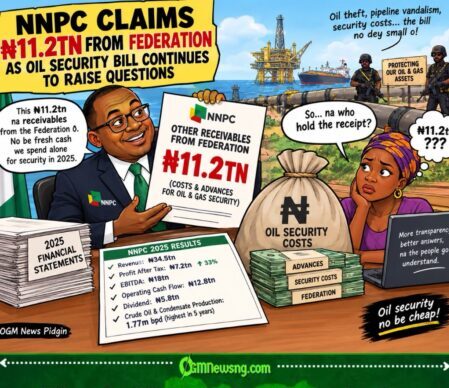
NNPC claims worth ₦11.2tn from the Federation don enter public discussion after the company’s 2025 audited financial statements reveal the size of receivables connected to advances and costs incurred on behalf of government. The figure include money linked to securing Nigeria oil and gas assets against crude oil theft, pipeline vandalism and other disruptions. But before anybody begin shout “₦11.2tn don disappear!”, the accounts get an important detail: this amount na receivable, meaning NNPC records am as money owed to the company, and e no mean say the entire amount represent fresh cash expenditure made solely for security during 2025.
NNPC Claims ₦11.2tn From Federation As Oil Security Bill Continues To Raise Questions
According to the financial statements, the ₦11.2tn under other receivables from the Federation includes advances to the Federation and costs incurred to secure oil and gas assets under an approved framework between government and NNPC. The company’s accounts therefore put NNPC claims inside a wider financial arrangement where NNPC can incur approved security-related costs and subsequently charge the Federation. With oil theft and pipeline vandalism continuing to affect production, the security responsibility no be small assignment; apparently, even the accounting for the assignment don carry plenty zeroes.
The important distinction be say the ₦11.2tn figure should not automatically be presented as ₦11.2tn of new “energy security expense” recognised in 2025. The accounts state that no energy-security expense was recognised during the year, compared with ₦7.13tn recognised in 2024. A reconciliation exercise with relevant government agencies resulted in energy-security cost receivables being netted against royalties, taxes and dividends due as of December 2024. So, as usual for government financial figures, the headline number fit catch attention quickly, but the small print get the real gist.
NNPC Claims ₦11.2tn As Oil Theft And Pipeline Vandalism Keep Turning Security Into Big Business
The broader NNPC claims story dey happen at the same time the national oil company reported stronger operating results. NNPC said profit after tax climbed from ₦5.4tn in 2024 to ₦7.2tn in 2025, while revenue stood at ₦34.5tn. The company also reported ₦18tn EBITDA, ₦12.8tn operating cash flow and a declared ₦5.8tn dividend. In production terms, crude oil and condensate output averaged about 1.77 million barrels per day, described by NNPC as its highest level in five years.
But better profit no automatically remove the public-interest question around oil security. The financial statements show how expensive the wider responsibilities surrounding the petroleum sector can become, while the company continues to deal with production protection, infrastructure, government obligations and commercial operations. NNPC’s 2025 results also came after the 2023 removal of petrol subsidy and the subsequent changes in the downstream petroleum market. The company has since been presenting itself as a commercially driven energy company under the Petroleum Industry Act framework, making the transparency around large government-related receivables particularly important.
The ₦11.2tn figure therefore deserves to be understood with both eyes open: one eye on the accounting definition and the other on the real cost of protecting Nigeria’s oil assets. NNPC claims no be simply another number to throw inside social-media argument; the composition, reconciliation and eventual settlement of the receivables are what will determine how clearly Nigerians can understand the financial burden. As more details from the accounts and government reconciliation emerge, OGM News Pidgin go continue to follow the money—because for this kind calculation, even calculator fit request annual leave.
Table of Contents
Discover more from OGM News NG
Subscribe to get the latest posts sent to your email.