
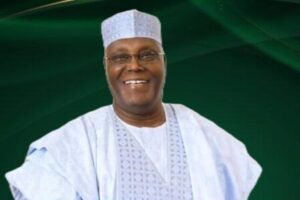

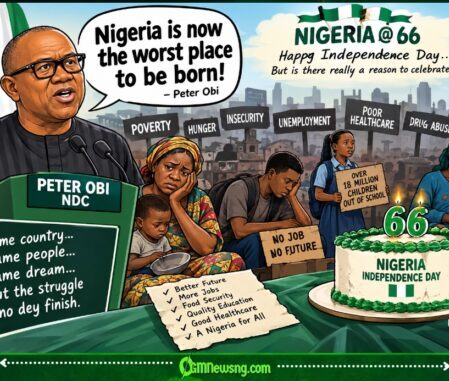
Nigeria don reach 66 years as independent country, but instead of everybody just chopping Independence Day cake and shouting “Nigeria we hail thee,” Peter Obi don bring serious matter enter the birthday table. For his October 1 Independence Day message, the presidential candidate of the Nigeria Democratic Congress (NDC) said Nigeria has become, in his words, “the worst place to be born,” while pointing at poverty, insecurity, unemployment, hunger, poor health outcomes and drug abuse as signs of a country under serious pressure. He blamed the APC-led administration for what he described as a widening gap between the promises made in 2023 and the reality Nigerians dey experience.
Poverty, Hunger and the Numbers Wey Peter Obi Put for Table
Peter Obi’s original message paint a very difficult picture of Nigeria. He said more than 140 million Nigerians dey live in poverty and severe hardship, while more than 18 million children remain out of school. He also raised alarm over insecurity, terrorism, banditry and kidnapping, referring to the recent death of 37 young Nigerians as another painful reminder of the danger facing citizens. According to him, the country’s challenge no be lack of resources but the failure to convert those resources into human development, productivity, security and shared prosperity.
But one figure from the material wey circulate online needs correction before social media turn am into another mathematical Olympics. Some versions of the report claim Obi said over 80 million children dey out of school. The full Independence Day statement attributed to him actually says over 18 million out-of-school children. UNICEF’s current education information says about 10.5 million Nigerian children aged 5–14 are out of school, while its 2025 annual report puts the broader number at about 10.2 million children. So the figures depend on the age range and methodology, but 80 million does not match the figure in Obi’s published statement.
Poverty, Food Crisis and Wetin Independent Data Dey Show
On food insecurity, Obi warned that more than 40 million Nigerians could face extreme hunger before the end of 2026. Independent food-security assessments confirm that Nigeria dey face a serious crisis, although the numbers and definitions no be exactly the same. FAO says about 36.3 million people were estimated to face Crisis-level acute food insecurity or worse during the June–August 2026 lean season. Earlier FAO projections put the number at 34.7 million, while the joint FAO-WFP Hunger Hotspots assessment estimated around 34.8 million people could face high levels of acute food insecurity during the same period.
The poverty situation too get plenty layers. World Bank estimates say more than 60 per cent of Nigerians were living below the national poverty line in 2025, while its current country assessment estimates 50.8 per cent, about 123 million people, lived below the lower-middle-income extreme-poverty threshold of $4.20 per day in 2025. The IMF, using a different measure, estimated national poverty at 63 per cent and said about 27 million Nigerians experienced food insecurity in late 2025.
At the same time, the World Bank says Nigeria has recorded improvements in macroeconomic stability and economic growth following recent reforms, even though household incomes have not fully recovered and poverty remains widespread. In other words, the economic story no be simply “everything don spoil” or “everything don better”; different indicators dey tell different parts of the story.
For healthcare and children, the numbers still show why Obi’s concerns dey resonate beyond political speeches. UNICEF data put Nigeria’s infant mortality rate at about 70 deaths per 1,000 live births and under-five mortality at 115.6 per 1,000 for 2024. UNICEF also says about two in five Nigerian children under five suffer from stunting, while around 10.2 million children are out of school according to its 2025 annual report. These figures show substantial challenges, even though some health indicators, including child mortality, have improved over the longer term.
So while Obi’s “worst place to be born” statement remains a political assessment rather than an internationally established ranking, the problems he listed are not imaginary. Nigeria genuinely faces major challenges around food insecurity, poverty, education, insecurity and human development. The important matter now na whether political leaders can move the conversation from speeches, counter-speeches and social-media arguments to measurable improvements for the people. As Nigeria continues the journey from its 66th Independence anniversary toward the 2027 election season, poverty and the wider question of living standards will likely remain among the biggest issues Nigerians go continue to debate.
Table of Contents
Discover more from OGM News NG
Subscribe to get the latest posts sent to your email.