








NATO Secretary-General Mark Rutte has issued a firm warning that the military alliance will defend against threats extending beyond Earth’s atmosphere, following alarming reports that Russia could be preparing to launch a nuclear-armed satellite into orbit. The development has raised fresh concerns about the possibility of turning space, which humanity has traditionally viewed as a frontier for exploration and scientific advancement, into another arena for military confrontation. Apparently, the competition between global powers is no longer satisfied with land, sea and air; even the stars may soon find themselves caught in the middle of international politics.
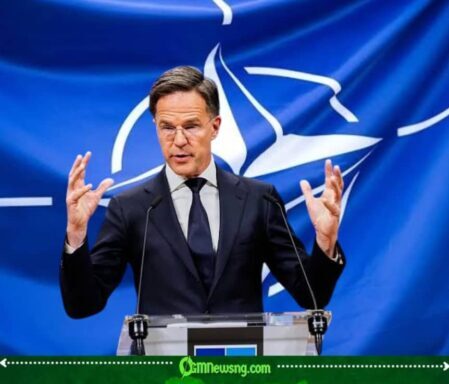
Speaking in Berlin on Monday, November 23, alongside German Chancellor Friedrich Merz, Rutte reaffirmed NATO’s commitment to protecting every inch of allied territory, making it clear that the alliance’s security responsibilities also extend to the space domain. His remarks followed reports from German media suggesting that Moscow could be preparing to deploy a nuclear-capable satellite, potentially introducing an extraordinarily dangerous dimension to an already tense international security environment.
NATO CHIEF MARK RUTTE EXTENDS DEFENCE WARNING BEYOND EARTH’S ATMOSPHERE
Addressing journalists, Rutte declared that NATO would ensure the protection of its members against threats in space, insisting that the alliance continuously evaluates its deterrence and defence capabilities. He also indicated that NATO possesses several response options, including measures that are not necessarily visible to the general public. In other words, while the world may be busy watching the skies, NATO says it is not simply standing around waiting for something unusual to appear on the radar.
The NATO chief’s remarks came as German intelligence assessments reportedly raised concerns about a Russian satellite project identified in media reports as Sputnik-S. According to reports citing German intelligence and military sources, the satellite is allegedly already constructed and being stored near Moscow, with a possible launch window emerging before the end of the year. Some assessments reportedly suggested that a launch could take place within approximately 60 days. However, these claims have not been independently established, and the reported launch timetable should not be mistaken for a confirmed Russian decision.
RUSSIA’S REPORTED NUCLEAR SATELLITE PLANS SPARK INTERNATIONAL CONCERN
The potential consequences of such a development are particularly disturbing because a nuclear detonation in low Earth orbit could have devastating effects on satellites operating in the affected region. These systems support essential services, including telecommunications, navigation, weather forecasting and military communications. Consequently, the danger would not necessarily be limited to NATO or Russia. Civilian infrastructure and countries far removed from any military confrontation could also suffer serious consequences. It would be an extraordinary situation in which humanity’s dependence on satellite technology could become one of its greatest vulnerabilities.
German Chancellor Friedrich Merz described the reports as shocking, suggesting that they reflected the level of escalation Russia might be prepared to pursue. Meanwhile, Russia’s Embassy in Berlin reportedly rejected the allegations, maintaining that Moscow’s space activities comply with international obligations and serve peaceful purposes. The Kremlin has also expressed scepticism towards reports based on unnamed sources. The disagreement leaves an important question hanging over the international community: are these reports an indication of a genuine emerging threat, or another development in the increasingly tense geopolitical contest between Moscow and Western governments?
For NATO, however, the issue is not entirely new. The alliance has previously identified space as an increasingly contested security environment, warning that satellites can be jammed, hacked or targeted by anti-satellite technologies. NATO also opposes placing nuclear weapons in orbit, which would violate Article IV of the 1967 Outer Space Treaty. With the possibility of a nuclear-armed satellite now attracting renewed attention, the NATO chief appears determined to make one thing clear: the alliance does not intend to leave its security interests unprotected simply because a potential threat is coming from above rather than across a traditional battlefield.
As tensions continue to develop, the possibility of a nuclear weapon entering Earth’s orbit is a matter the international community cannot afford to dismiss lightly. Whether the reported Russian satellite project eventually materialises or remains an intelligence concern, the implications could extend far beyond the immediate rivalry between Moscow and NATO. And if global powers are already preparing their responses to potential threats in space, perhaps humanity should start appreciating its satellites a little more. Stay with OGM News NG for further updates as this developing international security story unfolds.
Table of Contents
Discover more from OGM News NG
Subscribe to get the latest posts sent to your email.