








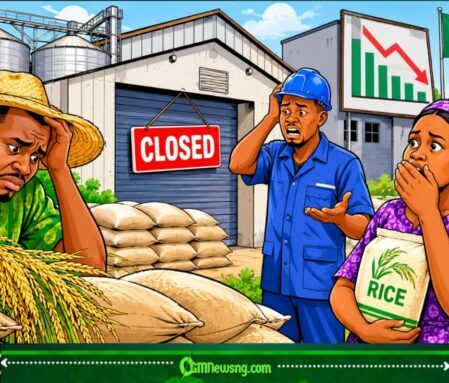
Nigeria’s much-celebrated rice revolution appears to be experiencing a serious harvest of disappointment, as more than 90 integrated rice mills across the country have reportedly shut down amid worsening production challenges, insufficient supplies of paddy rice, rising operational costs and competition from cheaper imported products. The development is raising fresh questions about the sustainability of Nigeria’s ambition to become self-sufficient in rice production. Apparently, the country that once proudly displayed rice pyramids as evidence of agricultural progress is now struggling to keep some of its rice factories alive. The revolution has not necessarily run out of slogans, but its factories are certainly running short of the raw materials needed to produce rice.
FROM NIGERIAN RICE PYRAMIDS TO SHUTDOWN NOTICES:
According to a report published on November 23, 2026, more than 90 of Nigeria’s 260 integrated rice mills have stopped operations, highlighting the growing difficulties confronting the domestic rice industry. The situation represents a major setback for a sector that once enjoyed considerable government attention and investment under previous agricultural development initiatives. In February 2023, the Federal Government showcased rice pyramids containing approximately one million bags of paddy in Abuja, presenting them as evidence of Nigeria’s progress towards agricultural independence. At the time, the country reportedly achieved about 75 per cent self-sufficiency in rice production and was looking forward to becoming a net exporter by 2026. Unfortunately, the journey from impressive rice pyramids to empty processing factories appears to have encountered some unexpected agricultural potholes.
The situation is particularly troubling because Nigeria possesses substantial rice-milling infrastructure, but the supply of locally produced paddy has reportedly declined considerably. Production figures cited in the latest report indicate that paddy output dropped from approximately 8.5 million tonnes in 2021 to about 4.8 million tonnes in 2025. Meanwhile, millers are reportedly struggling with insufficient raw materials, leaving expensive processing equipment underutilised.
Some farmers have also abandoned rice cultivation for alternative crops because the economics of rice farming have become increasingly difficult. In other words, Nigeria has invested in factories capable of processing enormous quantities of rice, but the farmers who should supply those factories are finding fewer reasons to continue planting it. It is a situation where the machines are ready for work, but the raw materials are nowhere to be found.
EXPENSIVE FARMING,ON NIGERIAN RICE ,CHEAPER IMPORTS AND GOVERNMENT POLICY QUESTIONS
One of the biggest problems confronting local rice producers is the rising cost of production. Industry operators reportedly disclosed that a tonne of paddy rice that sold for approximately ₦180,000 in 2021 now costs between ₦600,000 and ₦650,000. Fertiliser prices have also increased significantly, while petrol prices have risen from approximately ₦250 to ₦1,400 per litre. These expenses have made locally processed rice increasingly expensive compared with imported alternatives. Consequently, local millers are struggling to compete in a market where consumers naturally pay attention to their pockets before making purchasing decisions. For Nigerian rice producers, the challenge is no longer simply about growing more rice; it is about producing rice at a price that ordinary consumers and commercial buyers can afford.
The growing presence of cheaper imported rice, including products entering through informal and illegal channels, has further complicated the situation. Earlier in March 2026, the Federal Government acknowledged that smuggling had contributed to the shutdown of nearly 90 rice mills, with the Rice Processors Association of Nigeria warning that surviving mills were operating below their installed capacity. Meanwhile, changes in import duties and other trade policies have generated concerns among domestic producers about their ability to compete.
The United States Department of Agriculture has also highlighted the difficulties facing Nigerian rice production, including elevated input costs, insecurity in farming communities and pressure from lower-priced imports. Even in Ebonyi State, reports indicate that several modern rice mills have stopped operating because farmers could not produce enough paddy to sustain them. Apparently, the rice revolution is facing competition from imported rice, expensive farming inputs and policy decisions, all at the same time.
Nigeria’s rice industry is therefore confronting a problem that cannot be solved simply by announcing another agricultural programme or unveiling another impressive rice pyramid. Farmers need affordable inputs, reliable markets, adequate security and profitable prices, while millers require consistent supplies of paddy, accessible financing and a business environment that allows locally processed rice to compete fairly.
For a country with millions of rice consumers and enormous agricultural potential, allowing its domestic processing industry to deteriorate would carry serious economic consequences, including job losses, weaker rural livelihoods and increased dependence on imported food. The Federal Government and relevant stakeholders must therefore move beyond policy announcements and deliver practical solutions that address the difficulties across the entire rice value chain.
Nigerians will be watching closely to see whether the country’s rice revolution can recover from this setback or whether more factories will join the growing list of shutdown facilities. OGM News Pidgin will continue monitoring developments and bringing readers further updates on this important agricultural and economic story.
Table of Contents
Discover more from OGM News NG
Subscribe to get the latest posts sent to your email.