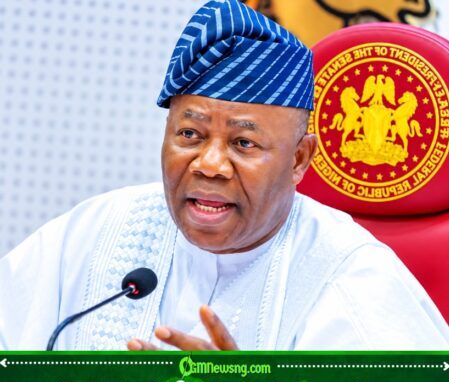









Saraki is set to face arraignment after a Kwara State High Court dismissed preliminary objections challenging its authority to hear a criminal defamation case, clearing the way for proceedings that could become one of the state’s most closely watched political legal battles. The court’s ruling not only keeps alive allegations that former Senate President Bukola Saraki published false and defamatory claims against Governor AbdulRahman AbdulRazaq, but also raises broader questions about the intersection of political speech, criminal defamation laws, and judicial independence in Nigeria.
Saraki Case Clears Major Legal Hurdle as Court Affirms Jurisdiction
A Kwara State High Court sitting in Ilorin has fixed July 22, 2026, for the arraignment of former Senate President Bukola Saraki after dismissing his preliminary application seeking to terminate criminal defamation proceedings instituted by the Kwara State Government. The prosecution alleges that Saraki published and circulated statements on or about April 17, 2026, through social media and newspapers claiming that Governor AbdulRahman AbdulRazaq lacked secondary school education. According to the charge, the government argues that the statements were knowingly false, insulting, and capable of provoking public disorder, contrary to Section 399 of the Penal Code, Cap. P4, Laws of Kwara State, 2006.
During the proceedings, Saraki’s legal team, led by Senior Advocate of Nigeria Jimoh Mumeen and represented in court by T.A. Ahmed, urged the court to dismiss the charge, arguing that the matter suffered from improper service, lack of jurisdiction, abuse of court process, and other procedural defects. However, prosecution counsel Rafiu Balogun maintained that the application lacked merit and should be dismissed. In his ruling, Justice M.O. Folorunsho resolved all seven objections in favour of the prosecution, affirming that the High Court possesses territorial jurisdiction to hear the matter. The judge further ruled that nothing contained in the charge sheet or supporting evidence suggested that the prosecution was politically motivated and noted that Saraki’s physical presence was not required while the interlocutory application was being determined. With the objections dismissed, the court ordered that Saraki be arraigned on July 22.
Saraki Trial Highlights Ongoing Debate Over Criminal Defamation and Political Expression
The Saraki case is unfolding against the backdrop of continuing national debates over the use of criminal defamation laws in Nigeria, particularly in disputes involving prominent political figures. While criminal defamation remains part of the criminal codes applicable in several states, legal practitioners and civil society organisations have repeatedly argued that such provisions can conflict with constitutional protections for freedom of expression if applied disproportionately. Courts have generally maintained that while free speech is protected, knowingly false statements capable of damaging reputations or disturbing public order may still attract legal consequences under existing statutes, depending on the specific facts established during trial.
The proceedings are also likely to attract significant public and political attention because they involve two of Kwara State’s most influential political figures, whose rivalry has shaped the state’s political landscape for years. Although Justice Folorunsho expressly rejected arguments that the prosecution appears politically motivated based on the material presently before the court, that determination relates only to the preliminary objection and does not amount to a finding on the substantive allegations. The prosecution must still prove every element of the alleged offence beyond reasonable doubt, while Saraki retains the constitutional presumption of innocence and the right to fully challenge the evidence when formal trial proceedings commence. For observers, the courtroom may become the arena where legal arguments—not political rhetoric—ultimately carry the greatest weight.
As the July 22 arraignment date approaches, Saraki and the Kwara State Government are expected to prepare for what could become a closely scrutinised legal contest with implications extending beyond the individuals involved. OGM News will continue to monitor developments, including the formal arraignment, any plea entered before the court, and subsequent proceedings that may further clarify the legal boundaries between political criticism, reputation, and criminal liability under Nigerian law.
Table of Contents
Discover more from OGM News NG
Subscribe to get the latest posts sent to your email.