









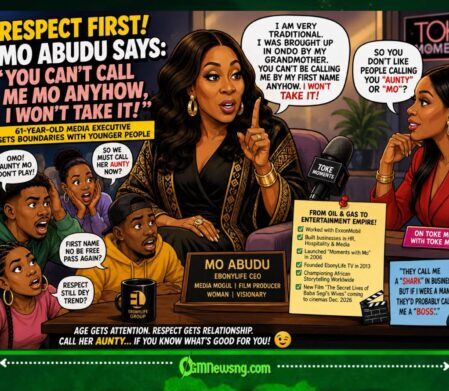
Respect don become the latest subject wey media mogul and EbonyLife founder Mo Abudu carry enter public conversation, after she made it clear that younger people should not casually call her by her first name. Speaking during her recent appearance on Toke Makinwa’s Toke Moments, the 61-year-old businesswoman described herself as “very traditional” and said her upbringing by her grandparents helped shape how she understands respect and proper ways of addressing older people. (Podscan)
For many Nigerians, the matter fit sound like ordinary family discussion until person remember say Nigeria get different schools of thought on titles. One person fit hear “Aunty” and feel say na respect; another fit hear “Aunty” and wonder whether dem don suddenly enter secondary school. But Abudu’s position appears less about demanding unnecessary ceremony and more about maintaining a traditional boundary she personally values.
Respect First: Mo Abudu Warns Younger People, “You No Fit Just Call Me Mo”
According to the account provided from the interview, Abudu said she would not accept younger people calling her first name “anyhow,” stressing that she is very traditional. Her comments came while Toke Makinwa asked about whether she was comfortable with being called “Aunty.” The discussion therefore touched something bigger than one person’s preferred title: the changing Nigerian culture around age, familiarity and respect.
Abudu’s own background gives additional context. Her official biography says she was born in Hammersmith, London, to Nigerian parents whose family roots are in Ondo Town, and that she moved to Nigeria at age seven to live with her grandparents before returning to England at 11. So while the supplied material mentions her upbringing and traditional outlook, available biographical information confirms that her childhood involved significant time with her grandparents in Ondo. (themoabudu.com)
The issue becomes especially interesting because Nigerian society has traditionally attached considerable importance to respectful forms of address. “Aunty,” “Uncle,” “Ma,” “Sir,” “Mummy” and similar titles can communicate age, familiarity or social respect depending on the relationship. For younger Nigerians growing up in a more informal culture, however, first-name calling has become increasingly normal in workplaces, entertainment and social media. That means the disagreement may not necessarily be about bad manners alone; sometimes na simply two generations using different dictionaries for the same word.
And this one fit make everybody laugh small: if person has spent decades building businesses, media platforms and an entertainment empire, perhaps “Aunty” is not exactly a heavy invoice to pay. But respect also works best when it is mutual and context-sensitive. The safest interpretation of Abudu’s comment is therefore that she has stated her personal preference, rather than that every Nigerian adult must adopt one universal rule for addressing elders.
Respect or Generation Gap? Mo Abudu Tells Younger People How She Wants To Be Addressed
Beyond the title controversy, Abudu’s latest conversation provides a useful reminder of how she reached the position where younger people are now debating what to call her. She began her professional career in human resources, later worked with ExxonMobil, founded Vic Lawrence & Associates and became involved in hospitality before moving into media. Her official biography says she launched Moments with Mo as part of her media journey, with the programme beginning in 2006, before she went on to establish EbonyLife TV in 2013. (themoabudu.com)
The latest Toke Moments episode adds more detail to that journey. Abudu explained that she entered media at about age 40, after already building business experience and professional relationships. She recalled approaching the then DStv platform with the idea of a Pan-African talk show and being told to find sponsorship herself. She subsequently secured sponsors and developed the project, while stressing the importance of relationships in business.
Her business philosophy also helps explain why the “shark” description came up during the conversation. Abudu discussed rejection, fundraising and the difficulty of convincing established people to support projects they do not control. She described having a strong presence and being principled about her work, while arguing that people sometimes judge powerful women differently from men. That point opens a wider conversation about how ambition is described depending on who is displaying it.
There is also plenty happening around her professionally. Her current public profile identifies her as CEO of EbonyLife Group, while recent updates show EbonyLife Place London nearing completion, with plans for a cinema and wider cultural space focused on African and Black films, alongside hospitality and lifestyle offerings. She has also been promoting The Secret Lives of Baba Segi’s Wives, which is scheduled for a Toronto International Film Festival world premiere before a nationwide Nigerian cinema release in December 2026. (LinkedIn)
So, beneath the jokes about whether “Mo” has become a restricted word, there is a serious lesson. Abudu’s comments reflect a generation that sees respect as something expressed through language and titles, while younger people increasingly see professional relationships as more informal. Neither side necessarily owns the entire truth. A person can prefer “Aunty” without demanding worship, just as somebody using a first name may not automatically mean disrespect. Context, relationship and consent still matter.
At the end of the day, Respect remains the real headline. Whether the preferred word is “Aunty,” “Ma,” “Madam” or simply “Mo,” the important thing is understanding the boundary of the person you are addressing. And if Mo Abudu has already announced her own boundary publicly, younger people wey value peaceful career and social life fit just save themselves unnecessary drama: when in doubt, “Aunty Mo” no dey carry bank charge.
Table of Contents
Discover more from OGM News NG
Subscribe to get the latest posts sent to your email.