









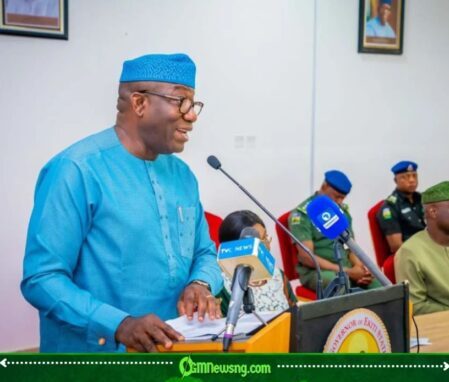
Re-election politics in Ekiti State took an unusual turn on Sunday as former Governor Kayode Fayemi congratulated Governor Biodun Oyebanji on his overwhelming electoral victory and appealed to opposition parties to support the re-elected governor rather than prolong political divisions. The appeal came after Oyebanji secured victories in all sixteen local government areas, a result that has already been described by many observers as one of the most decisive mandates in the state’s democratic history.
Fayemi Says Election Is Over, Governance Must Begin Again in Ekiti
Fayemi, through a statement issued by his media office, described the outcome as a resounding vote of confidence in Oyebanji’s leadership and a clear endorsement of his administration’s performance. He commended voters for their peaceful participation and praised electoral and security agencies for the conduct of the election. More notably, he extended what amounted to a political olive branch to opposition candidates, insisting that elections are contests and not wars and urging all parties to focus on the development of Ekiti State.
The former governor Fayemi further appealed to Ekiti indigenes at home and abroad to rally behind the administration as it begins another term in office. His remarks reflected a broader message of unity, arguing that the state has historically made progress whenever political actors set aside differences and pursued common goals. The appeal also reinforced the growing perception that Oyebanji’s administration has managed to build support that cuts across political and ideological lines.
Oyebanji’s Landslide Victory Sparks Fresh Appeals for Political Unity
The re-election result is historic because it reportedly marks the first time a sitting governor in Ekiti State has secured another term by winning all sixteen local government areas, effectively breaking what many political commentators had described as a succession jinx in the state. Ahead of the election, several political stakeholders and former governors had publicly endorsed Oyebanji’s second-term bid, portraying the election as a referendum on his performance in infrastructure, agriculture, healthcare and human capital development. Reports before the election also indicated that his campaign team had openly targeted victory in every local government area and every polling unit in the state.
Political analysts say the scale of the victory may reshape the conversation around opposition politics in Ekiti. While landslide victories often project stability and public confidence, they also raise questions about the future competitiveness of the political space. Supporters of the governor argue that the outcome is evidence that voters rewarded performance and continuity, while critics insist that a healthy democracy requires vibrant opposition voices. Regardless of interpretation, the election has placed Governor Oyebanji under even greater scrutiny, as expectations for accelerated development are likely to rise alongside the size of his electoral mandate.
The unity message coming from Fayemi may therefore prove to be one of the defining themes of the post-election period. The governor’s second term begins with an extraordinary political advantage and a level of public trust rarely seen in recent Ekiti politics. Whether this historic re-election becomes a turning point for governance or simply another political milestone will depend on how effectively that mandate is translated into measurable improvements in the lives of the people. OGM News Nigeria will continue to monitor developments as the new administration settles into its next chapter.
Table of Contents
Discover more from OGM News NG
Subscribe to get the latest posts sent to your email.