









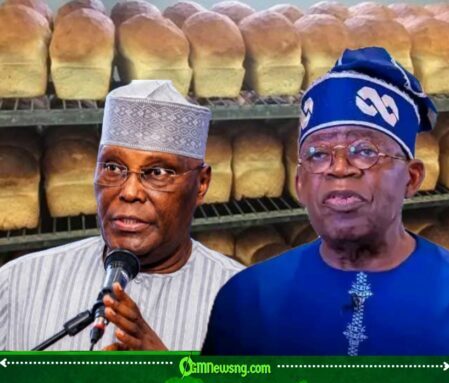
Nigeria’s economic challenges have once again provided ammunition for political criticism, with former Vice-President and African Democratic Congress (ADC) presidential hopeful, Atiku Abubakar, accusing President Bola Tinubu’s administration of allowing the country’s business environment to deteriorate while ordinary Nigerians struggle to afford basic necessities. With nearly 40 per cent of bakery operators reportedly forced out of business within two years and cooking gas reaching ₦1,800 per kilogram in parts of Abuja, the country’s economic difficulties are becoming increasingly difficult to dismiss as mere political propaganda. Apparently, even the humble loaf of bread is beginning to feel the weight of Nigeria’s economic reality.
Atiku made the remarks in a statement published on Saturday, November 14, 2026, on his X account, as his campaign team prepared for a political rally in Bauchi State. He argued that the closure of businesses, rising production expenses and increasing household energy costs demonstrated the human consequences of the country’s economic difficulties. His criticism raises an uncomfortable question for the Tinubu administration: if businesses are struggling to remain open and families are finding it increasingly difficult to survive, how much longer can Nigerians be asked to exercise patience?
40% OF BAKERIES SHUT DOWN AS BUSINESS OPERATORS STRUGGLE TO SURVIVE
Atiku’s criticism comes against the background of a worrying disclosure by the Premium Breadmakers Association of Nigeria (PBAN), which confirmed that approximately 40 per cent of its members had shut down their businesses within two years. The association attributed the situation to rising energy expenses, expensive borrowing and worsening operating conditions. Its president, Emmanuel Onuorah, reportedly called for government intervention through grants and affordable single-digit interest loans to prevent further damage to the baking industry.
For an industry responsible for producing one of Nigeria’s most widely consumed food items, the development carries serious economic implications. Bakeries require electricity, diesel, flour, transportation and other essential inputs to maintain production. When these expenses become unbearable, business owners are left with difficult choices: increase the price of bread, reduce production, lay off workers or close their doors completely. In other words, the economic crisis is no longer confined to government statistics; it is increasingly visible in the businesses disappearing from neighbourhoods and the prices appearing on shop shelves.
COOKING GAS HITS ₦1,800 AS ATIKU QUESTIONS GOVERNMENT BORROWING
The situation is not limited to the baking industry. Cooking gas prices have also increased, adding another burden to households and small businesses already struggling with rising living expenses. Market checks conducted on November 12 showed that some retail outlets in Abuja were selling liquefied petroleum gas (LPG) for as much as ₦1,800 per kilogram, while prices reached approximately ₦1,650 in parts of Lagos and Ogun states. The increases followed a reported 31.8 per cent rise in depot prices within a month, from ₦1,100 to ₦1,450 per kilogram.
Atiku questioned the government’s borrowing priorities, arguing that Nigerians deserve to know how borrowed funds are being utilised when local businesses continue to struggle. He alleged that corruption was benefiting from the government’s borrowing rather than ordinary citizens. These are serious political accusations that require evidence and a response from the administration. Nevertheless, his broader argument highlights a legitimate public-interest concern: Nigerians want to see economic policies translate into functioning businesses, affordable energy, employment opportunities and improved living conditions, rather than simply hearing repeated assurances of future prosperity.
The Tinubu administration, meanwhile, faces the difficult task of demonstrating that its economic reforms can deliver meaningful relief to households and businesses. While global energy-market pressures, domestic supply challenges and other operating costs contribute to rising prices, Nigerians will naturally judge economic policies by their practical consequences. After all, economic recovery becomes considerably less convincing when the baker cannot afford to bake, the consumer cannot afford the bread and the household struggles to refill its cooking-gas cylinder.
Atiku’s latest attack has reopened the debate over the effectiveness of President Tinubu’s economic policies, particularly as reports of widespread bakery closures and rising cooking-gas prices expose the difficulties facing businesses and households. Whether the government accepts the criticism or considers it another opposition political attack, the central issue remains the same: Nigerians need an economy in which businesses can survive, jobs can be protected and basic necessities remain affordable. For now, the political argument is heating up almost as quickly as the price of cooking gas. Stay with OGM News NG for further updates as the government, opposition and affected business operators respond to this developing economic story.
Table of Contents
Discover more from OGM News NG
Subscribe to get the latest posts sent to your email.