
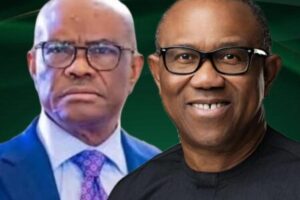

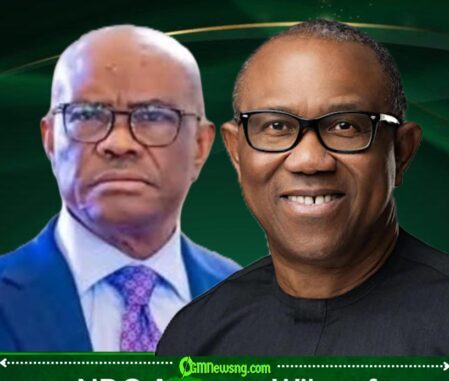
The political battle over patriotism, national unity and the national anthem has taken another dramatic turn, with the Nigeria Democratic Congress (NDC) challenging the Minister of the Federal Capital Territory, Nyesom Wike, to examine his own political record before questioning the commitment of its presidential candidate, Peter Obi, to Nigeria’s unity.
The NDC, through its National Campaign Council spokesperson, Dr Chiogo Constance Ikokwu, accused Wike of contributing to political divisions and instability, particularly in Rivers State. The response followed Wike’s criticism of Obi over an incident at an NDC town hall meeting in Lagos, where the presidential candidate and some supporters reportedly declined to participate in the rendition of the current national anthem but joined the crowd in singing the previous version.
Apparently, Nigeria’s national anthem has now become another battlefield for politicians, with each side seemingly convinced that it holds the exclusive certificate of patriotism.
Wike’s Patriotism Lecture Triggers Political Counterattack
Wike had accused Obi of disrespecting Nigeria and its national symbols, describing his conduct during the anthem controversy as lawless. The FCT minister argued that anyone aspiring to become Nigeria’s president should demonstrate respect for the country’s national identity, questioning Obi’s commitment to national unity.
However, the NDC was unimpressed by the minister’s lecture. Ikokwu challenged Wike to look at his own political history, arguing that his involvement in Rivers State’s political controversies and activities across party lines made him an unsuitable person to position himself as the moral referee of Nigerian politics.
In a particularly sharp response, the NDC spokesperson suggested that Wike should resolve the political disagreements associated with his own political camp before attempting to teach other politicians lessons about tolerance and responsible leadership. In other words, the party appears to be telling the minister that the national unity classroom should not be turned into a place where the teacher refuses to answer questions about his own political homework.
From National Anthem Controversy to Economic Hardship
The NDC also disputed the interpretation of the Lagos incident, insisting that the rendition of the previous anthem was spontaneous and initiated by members of the audience rather than deliberately organised as a political statement. The party maintained that another section of the video showed participants subsequently singing the current national anthem.
Nigeria’s anthem controversy has an important historical dimension. President Bola Tinubu signed the National Anthem Bill into law on May 29, 2024, restoring Nigeria, We Hail Thee, which served as the country’s anthem from independence in 1960 until 1978. It replaced Arise, O Compatriots, which had served for 46 years. Consequently, the distinction between the two versions is central to understanding the latest political disagreement. TheCable +2
But the NDC wants Nigerians to look beyond the musical disagreement. The party argued that economic hardship, the rising cost of living and the performance of the APC-led government deserve greater attention than arguments over who stood, who remained seated and who sang which version of the national anthem.
With the 2027 general election approaching, the party insists that Nigerians should judge political leaders by their economic policies, governance records and ability to improve living conditions rather than by isolated moments at political gatherings.
The controversy also comes at a politically significant moment. INEC’s revised timetable places the presidential and National Assembly elections on January 16, 2027, making the economy, political alliances and candidates’ public conduct increasingly important issues in the unfolding campaign. Independent National Electoral Commission +1
Ultimately, the NDC-Wike confrontation raises a bigger question about political accountability in Nigeria: should politicians judge one another’s patriotism through symbolic gestures, or should their records in governance, political conduct and economic management carry greater weight? While Wike has questioned Obi’s commitment to national symbols, the NDC has turned the spotlight towards the minister’s own political history. Whether this exchange will influence public perception ahead of the 2027 elections remains to be seen. Readers should watch out for further developments as OGM News NG continues to follow the story.
Table of Contents
Discover more from OGM News NG
Subscribe to get the latest posts sent to your email.