







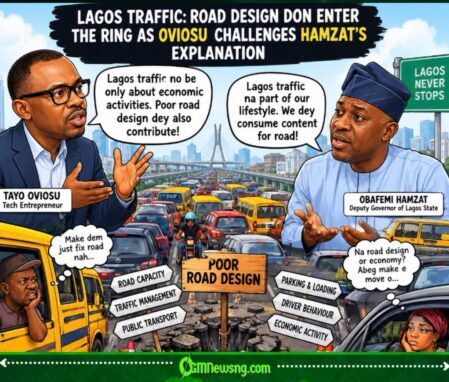
Lagos Traffic don once again become topic for serious argument, after tech entrepreneur Tayo Oviosu reportedly challenged Deputy Governor Obafemi Hamzat’s recent remarks about the city’s notorious gridlock, putting road design directly inside the conversation. The matter no be small one because for Lagos resident wey spend two hours looking at the same danfo from one junction, any serious explanation for traffic automatically become public interest matter.
The immediate controversy revolves around how Lagos should understand its traffic problem. Hamzat recently described traffic as something deeply connected with everyday Lagos life and even linked the situation with the creative economy, noting that people consume entertainment while stuck on the road. Oviosu’s reported intervention shifts attention back to the physical environment: how roads, junctions and transportation infrastructure are designed and whether some of them are creating bottlenecks before motorists even get opportunity to misbehave.
Lagos Traffic Don Enter Classroom As Tayo Oviosu Gives Road Design Free Lecture
According to the material provided to OGM News Pidgin, Oviosu’s central argument be say road design deserves much more attention when authorities discuss the reasons behind Lagos Traffic. The argument essentially challenges the idea that economic activity and the city’s busy lifestyle alone can explain the daily gridlock. If road capacity, junction arrangement and traffic flow no match the number of vehicles using them, even perfectly behaved motorists can still find themselves moving like procession.
There is historical support for examining that angle. Earlier Lagos urban transport documentation identified locations where congestion was associated with poor road design alongside commercial bus operations, roadside trading and uncoordinated loading. At some junctions, buses used road lanes as parking or loading spaces, while poor junction layouts further restricted movement. So, blaming only motorists or economic activity would leave part of the story outside the newsroom gate. But at the same time, saying road design alone causes all Lagos Traffic would also oversimplify a problem with several moving parts.
Lagos Traffic: Is Poor Road Design The Real Culprit Behind The Daily Gridlock?
Available research gives a wider picture. A study specifically examining traffic congestion in Lagos identified poorly planned road networks and traffic-management problems among important contributors, alongside high traffic density, limited road capacity, lane indiscipline and inadequate supporting infrastructure. It recommended stronger urban transport planning, mass transit and better traffic management rather than relying on one solution. Research into road safety in Nigeria has similarly identified poor road design, road-user behaviour, enforcement and other institutional factors as interconnected issues.
And the infrastructure side of the debate is not new to Hamzat. In earlier discussions about Lagos development, he has spoken about drainage, road capacity, high-traffic corridors and the cost of infrastructure. He has also previously acknowledged that Lagos traffic problems require different solutions at different locations rather than one magic formula for the entire metropolis. That context makes the present argument less like two people shouting across a traffic island and more like a wider policy conversation about how a megacity should move people efficiently.
At the end of the day, Lagos Traffic no be mathematical equation where one person fit write “economic activities” or “road design” for the answer sheet and collect full marks. Economic activities naturally generate movement, while bad road layouts, inadequate capacity, poor parking arrangements, public transport operations, enforcement and driver behaviour can determine how smoothly that movement happens.
The practical question for Lagos therefore remains how government, planners, engineers and transport operators can identify the exact causes of each major bottleneck and design solutions around them. As the debate continues, OGM News Pidgin go dey watch whether the next chapter go bring more road redesign, better traffic management—or another Lagos explanation that motorists will read while waiting for the light to change.
Table of Contents
Discover more from OGM News NG
Subscribe to get the latest posts sent to your email.