





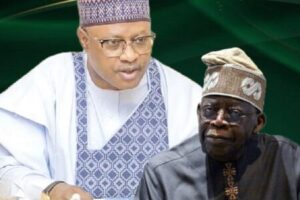


The political landscape in Enugu State is undergoing a significant transformation following the mass defection of key members of the Peoples Democratic Party (PDP) to the ruling All Progressives Congress (APC). Among the latest defectors is Sunday Udeh-Okoye, former PDP National Secretary, who has expressed strong confidence that the APC will secure a sweeping victory in the 2027 presidential election.
Speaking shortly after his defection, Udeh-Okoye declared that the next presidential election would be “a landslide for the APC in Enugu.” According to him, the wave of defections has shifted the political structure of the state in favour of the ruling party. He argued that the APC now has the strength and structure it previously lacked, ensuring its dominance in the next polls.
The former PDP stalwart attributed the party’s earlier struggles in Enugu to its weak organizational presence, noting that the current alignment of political heavyweights in the state has completely changed the equation. “Those who win elections for the party—at that moment, we were not in APC. Now, all of us are in APC. Anybody you like field in any political party, I assure you in Enugu State, APC will win,” he emphasized.
Peter Obi’s Influence ‘No Longer a Threat’ — Udeh-Okoye
Asked whether the APC could still triumph in Enugu if Labour Party’s Peter Obi returns to the ballot in 2027, Udeh-Okoye maintained that the ruling party’s victory was inevitable. He dismissed the notion that Obi’s candidacy or the Obidient movement would significantly impact the APC’s chances in the state.
“Even if Peter Obi is on the ballot, APC will win,” he asserted confidently. Udeh-Okoye explained that Obi’s impressive performance in the 2023 presidential election was largely due to the absence of a viable APC structure at the time. Now, with most of the PDP’s former political machinery absorbed into the ruling party, he believes the outcome would be different.
He further stated that the perception that Southeasterners would never vote for the APC was misplaced, arguing that attitudes in the region were evolving. According to him, the alleged neglect of the Southeast under former President Muhammadu Buhari had shaped such views, but current developments under new leadership have begun to change opinions.
Southeast Politics Shifting as APC Expands Control
With Enugu’s recent political realignment, three out of the five Southeastern states—Imo, Ebonyi, and Enugu—are now under the control of the APC. The remaining two, Abia and Anambra, are governed by the Labour Party and the All Progressives Grand Alliance (APGA), respectively.
Udeh-Okoye hinted that another Southeast state may soon join the ruling party, though he declined to specify which. He emphasized that Governor Peter Mbah’s performance and visible development efforts had improved the APC’s image in the state, further strengthening its grassroots support.
According to him, the growing acceptance of the APC in Enugu reflects a broader regional trend of political pragmatism. “Ndigbo are beginning to see results,” he said, suggesting that the Southeast is poised to play a more influential role in Nigeria’s national politics through stronger engagement with the ruling party.
Sunday Udeh-Okoye’s defection and his bold predictions highlight a major shift in Enugu’s political dynamics ahead of the 2027 elections. Whether his confidence translates into electoral success remains to be seen, but the growing momentum of the APC in the Southeast signals an emerging chapter in the region’s political evolution.
Table of Contents
Discover more from OGM News NG
Subscribe to get the latest posts sent to your email.