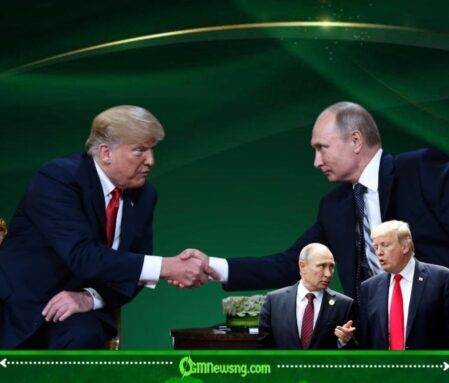






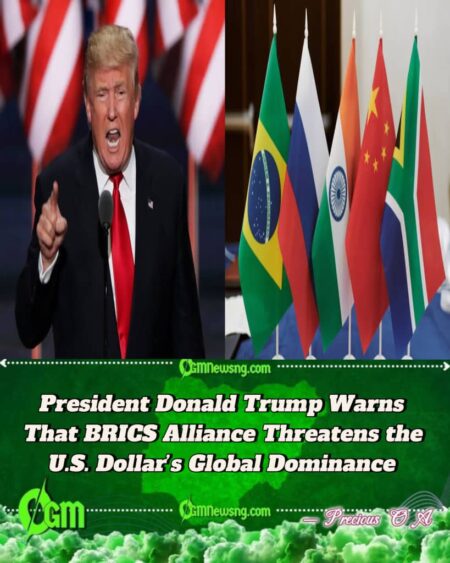
President Donald Trump framed his position in stark terms: “It’s an attack on the dollar, and we’re not going to let anybody attack the dollar,” he said, tying this to BRICS — an alliance made up of Brazil, Russia, India, China, and South Africa — and its growing ambitions. He specifically claimed that BRICS was conceived to “degenerate” the U.S. dollar and warned that any country aligning with such goals would be penalised. His remarks followed recent statements from BRICS leaders about strengthening trade and financial cooperation through non-dollar mechanisms.
President Donald Trump has made clear that at the core of his threat is a return to aggressive tariff policy. He has revived language promising 100 percent tariffs on any country that dares to replace or back a currency in competition with the dollar. More recently, he has softened this to a 10 percent additional tariff on nations he classifies as following “anti-American” BRICS policies. The message from Washington remains clear — any economic bloc perceived to challenge U.S. financial supremacy will face consequences.
President Donald Trump insists the approach is necessary to preserve what he calls “the standard” — the dollar’s status as the world’s principal reserve and trade currency. “If you have a smart president, you will never lose the standard,” he said in defense of his position. For Trump, protecting the dollar is synonymous with protecting American power, jobs, and global influence.
President Donald Trump has also accused BRICS of operating as a “shadow alliance” seeking to weaken Western-led institutions such as the IMF and World Bank. According to him, the U.S. must remain vigilant to prevent what he described as an “economic ambush” orchestrated by rival powers within the coalition. His administration has reportedly instructed U.S. trade and Treasury officials to “review” partnerships with BRICS-affiliated development banks.
Economic Fault Lines: Repercussions of Trump’s Strategy
President Donald Trump’s tariff threats have drawn broad scrutiny from economists and trade experts, who warn of serious blowback. A study by the Peterson Institute suggests that carrying out such sweeping tariffs would likely slow growth and push up inflation both in the U.S. and among targeted countries. Analysts say that while Trump’s aggressive rhetoric appeals to domestic audiences, it risks reigniting a global trade war reminiscent of his first term in office.
President Donald Trump faces criticism that another trade conflict could isolate the U.S. from major partners. Nations subject to punitive duties would have strong incentives to accelerate efforts toward de-dollarisation, creating more investment in local or regional currencies. With BRICS members already exploring alternatives — such as settlement in national currencies or the development of a digital BRICS payment system — the move could backfire, potentially speeding up the very trend he seeks to prevent.
President Donald Trump’s proposal also threatens to disrupt global supply chains, especially in sectors heavily dependent on exports to the U.S. Companies within BRICS nations may see demand shrink, while American importers might face increased costs on key goods such as electronics, energy products, and raw materials. Economists also warn that higher tariffs could weaken consumer purchasing power within the U.S., straining lower-income households.
President Donald Trump’s economic advisers maintain that the current tilt toward de-dollarisation is reversible, but many analysts disagree. The U.S. dollar already sees a diminishing share in global reserves and cross-border transactions, even as it remains dominant. Nations such as China, India, and Russia have gradually sought to diversify foreign reserves to reduce vulnerability to U.S. sanctions. Thus, aggressive enforcement may accelerate trends Trump is trying to resist.
BRICS Explained: The Coalition Redefining Global Finance
President Donald Trump has repeatedly targeted BRICS in speeches, portraying the bloc as an “economic threat masquerading as cooperation.” BRICS, an acronym representing Brazil, Russia, India, China, and South Africa, was formed in 2009 to promote trade, investment, and political cooperation outside traditional Western frameworks. The bloc has since expanded its influence, and several new members — including Saudi Arabia, Egypt, Iran, and the United Arab Emirates — have joined or expressed interest in membership. Together, BRICS nations account for over 40 percent of the world’s population and nearly one-third of global GDP, making it a significant force in global economic affairs.
At the heart of BRICS’s recent agenda is “de-dollarisation,” a push to reduce dependence on the U.S. dollar in international trade. This includes using national currencies for settlement, creating development banks that lend outside Western financial systems, and even exploring the possibility of a common digital currency. Supporters argue that this diversification promotes fairer trade and shields developing economies from external shocks tied to U.S. monetary policy.
For the world, BRICS represents a symbolic shift — a movement toward a multipolar financial order where economic power is shared more broadly among regions. However, critics view the initiative as fragmented, pointing to internal differences among members and questioning the feasibility of replacing the dollar’s liquidity and trust.
Still, the bloc’s steady growth has drawn attention from the West. Its institutions, such as the New Development Bank (NDB), have become alternatives to the World Bank for infrastructure funding in the Global South. For developing countries struggling under U.S.-linked debt, BRICS’s model offers a new economic path — one that President Donald Trump views as an existential threat to U.S. influence.
BRICS Pushback and Global Responses
President Donald Trump’s confrontational approach has been met with firm resistance. BRICS leaders have generally dismissed his accusations of being “anti-American,” choosing instead to cast the bloc as a vehicle for greater multipolar balance and economic autonomy. Brazil’s President Luiz Inácio Lula da Silva rejected the notion of a U.S. emperor dictating global finance rules, calling the world’s order “long overdue for reform.” Russia’s foreign ministry accused the U.S. of “economic intimidation,” while China reaffirmed that BRICS’s goal was “win-win cooperation, not confrontation.”
Many BRICS nations have made no firm commitment to a new unified currency — rhetoric around de-dollarisation has often been cautious and tempered by recognition of systemic risk. Some have instead focused on strengthening BRICS Pay, a payments mechanism enabling trade settlement in local currencies. This, members argue, is not an “attack” on the U.S. dollar, but a move toward greater financial independence.
Diplomatic reactions outside BRICS have also been notable. European leaders have watched cautiously, worried that President Donald Trump’s aggressive trade stance could spark a broader financial divide between the West and emerging economies. The European Union’s trade commissioner described his tariff threats as “unsettling” for global markets, warning that “a weaponised dollar benefits no one.”
The unfolding standoff signals a deeper contest not just over currency dominance, but over the future of the international financial system. Whether President Donald Trump’s strategy succeeds in halting BRICS’s momentum — or instead accelerates the world’s shift toward alternative systems — remains one of the defining questions of this new geopolitical era.
Table of Contents
Discover more from OGM News NG
Subscribe to get the latest posts sent to your email.