





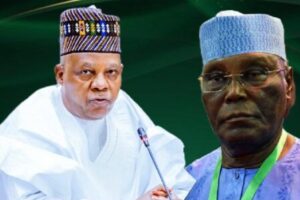




Nigeria’s petrol stations may soon need two price boards: one for the cost of fuel and another for the cost of explaining why it costs that much. Former Vice President and African Democratic Congress presidential candidate Atiku Abubakar has launched a fresh attack on President Bola Tinubu’s economic policies, questioning how Nigerians can be paying as much as ₦1,470 per litre when crude oil is reportedly around $102.52 per barrel. His central demand is simple: investigate the money flowing through the Federation Account Allocation Committee (FAAC) and account publicly for the revenues and savings generated since fuel subsidy removal.
Atiku’s argument comes with a particularly uncomfortable historical comparison. He pointed to 2008, when crude oil reached about $147 per barrel, yet petrol sold at roughly ₦65 per litre under the administration of the late President Umaru Musa Yar’Adua. Today, Nigerians face dramatically higher pump prices while household incomes remain under severe pressure. The political punchline, in Atiku’s telling, is that the barrel of oil appears to have become cheaper while the Nigerian motorist has somehow become more expensive.
The FAAC Numbers That Refuse to Stay Quiet
Atiku is demanding a comprehensive reconciliation of Federation Account revenues from 2023 to date, including gross collections, deductions, the legal basis for those deductions, receiving accounts and ultimate beneficiaries. His demand draws attention to publicly released FAAC figures. For June 2025, the Federal Ministry of Finance reported ₦4.232 trillion in gross revenue, while ₦1.818 trillion was distributed to the three tiers of government. The official figures also recorded ₦162.786 billion for cost of collection and ₦2.251 trillion for transfers, interventions, refunds and savings.
That arithmetic does not automatically establish wrongdoing, and Atiku’s allegations should not be mistaken for proven facts. But it does explain why the figures have become political ammunition. If Nigerians are being told that painful reforms are necessary to rescue the economy, Atiku argues that citizens should also be able to see exactly where the resulting revenues and savings are going. In the world of Nigerian politics, apparently, transparency has become another commodity whose price is still being negotiated.
Atiku Calls for Investigation Into FAAC Deductions as Fuel Price Rises
The former vice president also wants scrutiny of oil-related revenues and arrangements involving the Renewed Hope Infrastructure Development Fund, OML 143, NNPC’s LNG operations, offshore structures, crude lifting and maritime surveillance contracts. He argues that the government should publish records and allow independent forensic auditors to reconcile the money if it believes the allegations are unfounded. His challenge is essentially a financial version of “show me the receipt.”
The broader issue is the impact of petrol prices on virtually every Nigerian household. Higher fuel costs feed into transportation, food distribution, farming, manufacturing and school expenses. Atiku therefore argues that the burden of subsidy removal cannot be considered in isolation from wages and living standards. His comparison with American fuel prices is designed to underline the imbalance: Nigerians may increasingly encounter international-level pump prices without enjoying anything close to international-level incomes.
For President Tinubu, the political challenge is now bigger than defending a fuel-pricing policy. The administration must also continue convincing Nigerians that the revenues and fiscal gains associated with its reforms are being properly accounted for and converted into tangible economic benefits. Whether Atiku’s allegations survive detailed scrutiny is a separate question—but the demand for clearer public accounting is unlikely to disappear simply because the political temperature rises.
The petrol pump may therefore remain Nigeria’s most honest economic commentator: every time the price changes, it reminds citizens of what their pockets already know. As Atiku demands answers on FAAC revenues and subsidy-removal gains, the real question now is whether the government’s books can speak loudly enough to compete with the noise at the filling stations. Watch OGM News NG for future updates on this developing story.
Table of Contents
Discover more from OGM News NG
Subscribe to get the latest posts sent to your email.