






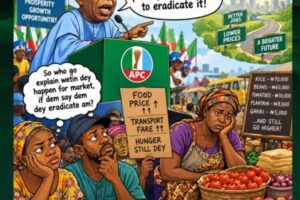


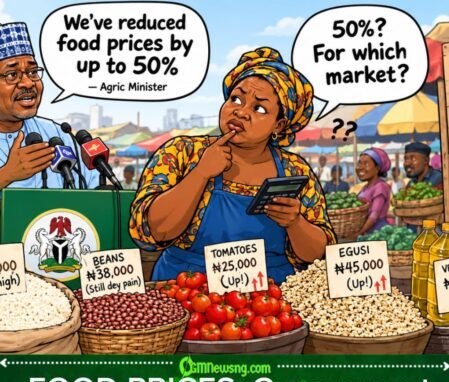
Food Prices don become fresh political and economic conversation after Minister of Agriculture and Food Security, Senator Abubakar Kyari, say prices of some essential food commodities don reduce by up to 50 per cent across Nigeria. But as government dey celebrate the claimed reduction, the big question for ordinary Nigerians be whether the reduction dey reach their plates, pockets and neighbourhood markets.
The minister make the statement on Monday for Maiduguri, Borno State, during Community of Practice meeting for state commissioners responsible for agriculture, health, environment and rural development. According to Kyari, government interventions, increased production, better delivery of farm inputs, rural infrastructure investment and support for smallholder farmers don help push down prices of some commodities.
FOOD PRICES: 50% DROP WEY GOVERNMENT DEY TALK ABOUT
Kyari say the country don see reduction of up to 50 per cent in prices of some essential food commodities, while government interventions continue to target agricultural production and food affordability. He also point specifically to the difference between the prices of commodities such as rice and maize now and their levels before 2023, asking stakeholders to look at the figures rather than turning the issue into political argument.
The minister’s position no be entirely new. Earlier in 2026, the Federal Ministry of Agriculture and Food Security also reported that essential commodities had recorded reductions of up to 50 per cent nationwide. Government linked the development to stronger local production, improved agricultural inputs and development of major value chains including rice, maize, wheat, yam, cassava, soybean and oil palm.
FOOD PRICES: MARKET REALITY STILL GET MANY SIDES
But the important word inside the minister’s statement na “up to.” That means the 50 per cent figure no automatically mean every food item don reduce by half or say every Nigerian for every market dey buy food at 50 per cent lower price. Recent market tracking for Lagos show mixed movement: 36 out of 67 monitored food items recorded price declines in September, but 16 still recorded increases. Egusi, tomatoes and vegetable oil were among items that went up.
Government also dey pursue wider measures to improve supply and reduce production pressure. In July, the Federal Government announced distribution of more than 10 million bags of fertiliser together with a guaranteed-price model targeting two million smallholder farmers. Earlier policy measures also included lower import duties on selected food and agricultural inputs as part of efforts to reduce inflationary pressure.
So, while the Food Prices claim get government data and official backing, Nigerians still need clear commodity-by-commodity figures, locations and time periods to understand exactly where the 50 per cent reduction dey happen. Because for market matter, saying “food don cheap” and showing exactly how much one bag of rice, maize, beans or other staple costs today na two different things. The market woman no dey price food with government press statement; she dey price am according to wetin supplier, transport, storage and replacement cost tell her.
The government’s agricultural interventions may be producing genuine improvement in some supply chains, but the real test of the Food Prices story na whether the reduction becomes consistent, widespread and obvious inside household budgets. If the claimed 50 per cent drop continue and reach more commodities, consumers go feel am; if some items continue climbing, Nigerians go still ask the same old question: “50 per cent don drop for where?” OGM News Pidgin go continue to watch the figures as market reality and official claims dey meet.
Table of Contents
Discover more from OGM News NG
Subscribe to get the latest posts sent to your email.