



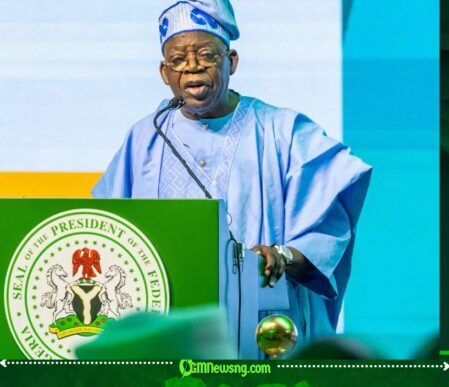
President Bola Ahmed Tinubu has doubled down on his decision to remove Nigeria’s petrol subsidy, insisting that he has no regrets and that the country will not return to the policy under his watch. Using the biblical story of Moses and the Israelites’ departure from Egypt, the President portrayed the controversial reform as a one-way journey towards economic recovery, even as millions of Nigerians continue to grapple with the cost of living. His message was unmistakable: the government believes the road ahead is forward, although many citizens may still be wondering when the promised economic relief will arrive.
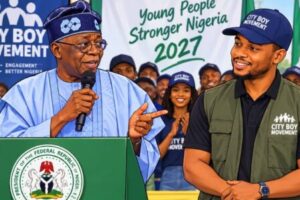
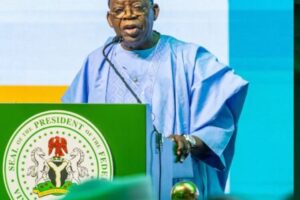
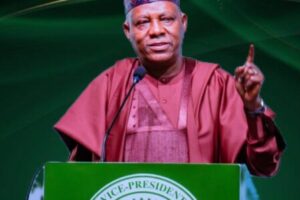
Speaking on Monday evening at an event titled Together Till 2027: An Evening with Original City Boy, organised by the City Boy Movement alongside the Relax-Tinubu-Is-Fixing-Nigeria movement, Tinubu defended his administration’s economic decisions while rallying young supporters ahead of the 2027 presidential election. The gathering, which also served as a platform for political mobilisation, provided the President with an opportunity to challenge critics of his reforms and present his policies as investments in Nigeria’s future.
NO REGRETS, NO RETURN: TINUBU TURNS SUBSIDY DEBATE INTO AN EXODUS STORY
Tinubu recalled removing the fuel subsidy on his first day in office in May 2023, arguing that Nigeria was facing severe financial constraints and could no longer sustain the expense. He said the country had inherited substantial obligations, including debts owed to airlines, weak foreign reserves and a troubling pattern of financing government expenditure. According to the President, difficult decisions were unavoidable, and reversing course would undermine the direction his administration had chosen. In his telling, the subsidy removal was not simply an economic measure; it was a decisive break with an unsustainable past.
To make his argument memorable, Tinubu invoked Moses, the Red Sea and the Israelites’ escape from Egypt. He declared that Nigeria could not be expected to return to the old subsidy arrangement, comparing such a reversal to asking Moses to return to Egypt after leaving captivity. The analogy gave the economic debate a dramatic biblical twist: subsidy removal became the exodus, while any attempt to restore it was portrayed as a journey backwards. Whether struggling motorists and households consider the comparison comforting is another matter entirely.
ATIKU’S ALTERNATIVE, RISING PETROL PRICES AND THE 2027 POLITICAL TEST
The President also took aim at former Vice-President Atiku Abubakar, the African Democratic Congress presidential candidate identified in the supplied report, over his proposal to restore a form of fuel subsidy. Atiku has argued for a capped and audited production subsidy linked to domestic refining, distinguishing his proposal from the former system, which critics associated with corruption, excessive public expenditure and poor accountability. The distinction matters: a targeted mechanism tied to domestic production is not necessarily identical to restoring the previous subsidy regime. Nevertheless, the disagreement highlights a major question for the 2027 election: should Nigeria continue with the current approach or consider a different way of cushioning consumers against fuel costs?
The financial consequences of subsidy removal remain central to that argument. Petrol prices rose sharply from the roughly ₦180-per-litre level cited in the supplied material to around ₦620 following the announcement, and subsequently reached approximately ₦1,200 per litre in some periods and locations. Actual pump prices vary by date, location and market conditions. For households facing higher transport fares, food prices and operating costs, the promise of long-term economic gains can feel distant from daily reality. Tinubu, however, insisted that Nigeria was moving in the right direction, pointing to economic growth and the need to stop relying excessively on borrowing. He also defended the Nigerian Education Loan Fund, saying more than one million students had received support through the student-loan programme.
Addressing his young supporters, Tinubu urged them to take his message to campuses, markets and villages, and encouraged eligible citizens to obtain their Permanent Voter Cards and participate in the election. He argued that the campaign was about their future rather than merely his political survival. Yet the political challenge remains substantial: supporters will want evidence that the reforms can produce jobs, stronger purchasing power and improved living standards, while opponents will continue to question whether the costs imposed on citizens are justified by the results.
Tinubu’s declaration leaves little doubt that he intends to defend fuel subsidy removal as a defining policy of his administration, turning the issue into both an economic argument and a test of political credibility ahead of 2027. But with petrol prices and household expenses remaining major concerns, the debate over whether Nigeria should maintain, modify or replace its current approach is far from settled. Stay with OGM News NG for further updates as the subsidy controversy, competing economic proposals and the race towards the next presidential election continue to unfold.
Table of Contents
Discover more from OGM News NG
Subscribe to get the latest posts sent to your email.