

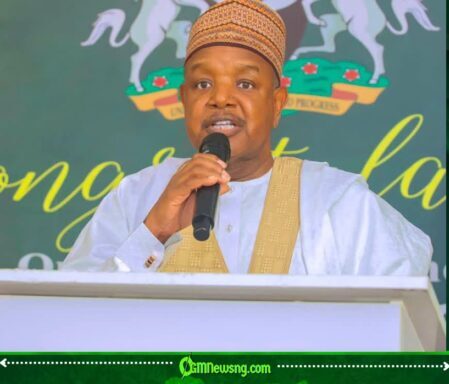
Senator Abubakar BaguduSenator Abubakar Bagudu, Nigeria’s Minister of Budget and Economic Planning, has said the country’s national budget remains too small relative to its population and development requirements.
Bagudu made the remarks on Monday, September 28, 2026, at a capacity-building workshop organised by the Senate Press Corps in Abuja. The workshop focused on legislative oversight, media collaboration and safeguarding the national budget from unlawful insertions.
Nigeria Has Limited Fiscal Space, Says Minister
According to Bagudu, Nigeria has one of the smallest national budgets among the world’s 10 most populous countries. He argued that the situation raises questions about whether the country has sufficient fiscal resources to meet its growing needs for infrastructure, public services and economic development.
The minister called for a broader national conversation on revenue mobilisation and expanding Nigeria’s fiscal space. He questioned whether the country should continue operating with relatively limited resources or explore additional ways of generating revenue to finance its development objectives.
Bagudu also compared Nigeria with countries with similarly large populations, including Pakistan and Brazil. He said Pakistan’s budget was about $67 billion, while Brazil’s federal budget was substantially larger than Nigeria’s, raising questions about the level of resources available for public investment and service delivery.
Minister Links Bigger Economy to Development Goals
Bagudu said the government’s long-term ambition of building a $1 trillion economy would require stronger revenue mobilisation, investment and, where necessary, borrowing supported by public confidence.
He also emphasised that the national budget is the product of negotiations involving the Executive and the National Assembly, with the legislature constitutionally responsible for appropriating public funds. He urged Nigerians and the media to understand the budget process while scrutinising government spending.
The minister cautioned journalists against automatically treating unfamiliar budget provisions as unlawful insertions without investigating their origin, purpose and intended beneficiaries. He said effective oversight should combine accountability with proper verification of facts.
Bagudu further noted that budget performance should not be judged solely by capital expenditure because recurrent commitments such as salaries, security and debt servicing are also necessary to keep government functioning.
Nigeria’s 2026 Budget Stands at N68.32 Trillion
The comments come as Nigeria operates a 2026 federal budget of N68.32 trillion. Separate analysis cited by PUNCH showed that the combined budgets of Nigeria’s 36 states and the Federal Capital Territory rose from N27.22 trillion in 2025 to N40.14 trillion in 2026.
Despite the increase in the combined state and FCT budgets, the share allocated to capital projects fell from 73.24 percent in 2025 to 64.34 percent in 2026. In absolute terms, however, capital expenditure increased from N19.94 trillion to N25.83 trillion.
Bagudu’s argument therefore centres not only on increasing the size of the annual budget, but also on expanding the country’s economic and revenue base so that government can sustainably finance development priorities.
He urged continued collaboration between the National Assembly and the media to strengthen transparency, accountability and public understanding of Nigeria’s budget process. The minister’s remarks have renewed discussion about the relationship between Nigeria’s population, revenue capacity and public spending. As the Federal Government pursues its long-term economic ambitions, the central fiscal challenge remains how to generate sufficient resources while maintaining responsible spending and financing essential development needs. OGM News NG will continue to monitor Nigeria’s economic and budgetary developments.
Table of Contents
Discover more from OGM News NG
Subscribe to get the latest posts sent to your email.