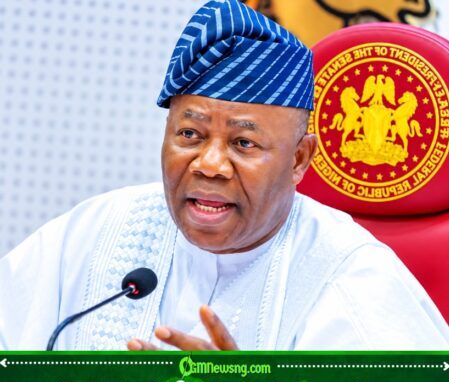









Senate President Godswill Akpabio has accused Godswill Akpabio of being repeatedly misrepresented in media reports, particularly by Arise News. In a statement that has since gone viral, the Senate President claimed he has completely stopped watching television, arguing that much of what is broadcast does not reflect his actual words.
The remarks have triggered widespread discussion across political and media circles, raising questions about accuracy, interpretation, and responsibility in broadcast journalism. While Akpabio did not provide specific instances in the brief statement, his frustration points to a broader concern about how political speeches are edited, framed, and replayed in fast-paced news environments.
MEDIA ACCURACY UNDER PRESSURE
The misquotation allegation by Akpabio against Godswill Akpabio is not an isolated complaint in Nigeria’s political history, where public figures frequently challenge the interpretation of their remarks. However, his direct reference to Arise News has reignited conversations about editorial standards and the pressure on media houses to deliver rapid, attention-grabbing headlines.
In his remarks, the Senate President suggested that repeated distortions have pushed him away from television consumption entirely. Analysts note that such statements, whether literal or rhetorical, reflect growing tension between political communication strategies and modern media cycles, where soundbites often overshadow full context.
BROADER MEDIA LANDSCAPE AND PUBLIC TRUST
Beyond the immediate controversy, the misquotation issue involving Godswill Akpabio highlights longstanding concerns in global journalism about context loss in edited broadcasts. Media experts often warn that selective clipping, headline framing, and social media amplification can alter public perception of political statements.
In the case of Arise News, the incident has sparked online debates over whether broadcasters should implement stricter verification protocols before airing politically sensitive content. While the network has not issued a detailed public response to this specific allegation, similar disputes in the past have typically led to calls for clarification or retraction.
As Nigeria’s political communication environment continues to evolve, the balance between speed, accuracy, and accountability remains under scrutiny. Observers suggest that the ongoing misquotation debate may further push both politicians and media organisations toward more cautious engagement in the future. The misquotation controversy surrounding Akpabio and Arise News reflects a deeper challenge in modern information flow—where perception often competes with precision—and it is expected that further clarifications or responses may emerge in the coming days as the story develops.
Table of Contents
Discover more from OGM News NG
Subscribe to get the latest posts sent to your email.