






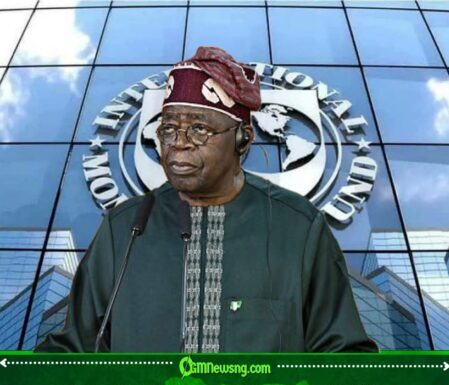
President Bola Ahmed Tinubu has come under renewed economic scrutiny after the International Monetary Fund (IMF) cautioned Nigeria against potential risks associated with a proposed $5 billion financing arrangement involving First Abu Dhabi Bank. The warning has placed the administration’s borrowing strategy under the spotlight, raising questions about transparency, debt management, and long-term financial sustainability.
While the proposed transaction is intended to support Nigeria’s financing needs and strengthen fiscal capacity, the IMF has warned that the structure of the arrangement may expose the country to risks that could become costly if economic conditions change unexpectedly.
Tinubu Financing Strategy Chastise by IMF
President Bola Ahmed Tinubu’s administration has pursued a range of economic reforms aimed at stabilizing public finances and attracting investment. Against this backdrop, the proposed $5 billion financing arrangement is viewed as part of broader efforts to secure capital for development priorities and government obligations.
However, the IMF has expressed concern about the complexity of the proposed structure, warning that derivative-based financing arrangements can sometimes obscure risks and create future liabilities. Analysts note that such transactions may expose borrowers to additional obligations if exchange rates move unfavorably or if pledged assets lose value.
The debate has fueled questions about whether Nigeria should prioritize alternative sources of financing that may offer greater transparency and predictability.
IMF Stance Known to Tinubu
The IMF has acknowledged progress made under President Bola Ahmed Tinubu’s economic reform agenda, particularly in efforts to improve macroeconomic stability. Nevertheless, the institution has emphasized that borrowing decisions must be carefully evaluated to avoid creating new fiscal vulnerabilities.
Economic experts note that international financial institutions often caution governments against overly complex debt instruments because they can increase uncertainty and complicate long-term financial planning. The IMF’s concerns therefore extend beyond the size of the loan itself and focus on the structure of the arrangement.
Supporters of the government’s approach argue that Nigeria requires substantial investment to address infrastructure and development challenges, while critics insist that every borrowing decision should be subjected to rigorous public scrutiny.
As discussions continue, President Bola Ahmed Tinubu finds himself at the center of a broader conversation about balancing development financing with prudent debt management. The government’s next steps regarding the proposed arrangement could have significant implications for investor confidence, fiscal stability, and Nigeria’s long-term economic trajectory.
Table of Contents
Discover more from OGM News NG
Subscribe to get the latest posts sent to your email.