









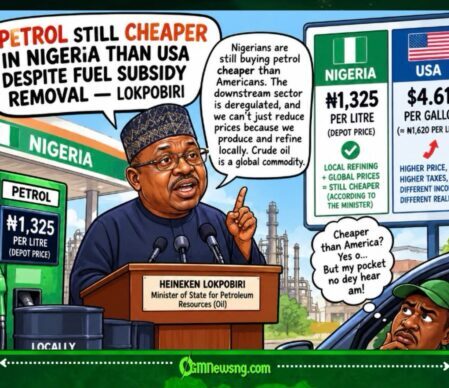
Petrol prices don once again enter national conversation after Minister of State for Petroleum Resources (Oil), Heineken Lokpobiri, defended Nigeria’s fuel-pricing system and argued that Nigerians are still buying petrol at a lower price than consumers in the United States. The statement came against the background of continuing concern over pump prices and the economic pressure fuel costs place on households and businesses.
Lokpobiri’s central explanation be say Nigeria’s downstream petroleum sector don enter full deregulation, meaning government no suppose simply dictate the price whenever motorists complain. According to the minister, the fact say Nigeria produces crude and now has significant local refining capacity does not mean the country can completely escape the international crude-oil market. The logic is simple on paper, although the reality at filling stations can make the paper start sweating.
Petrol Prices: Lokpobiri Says Nigerians Still Buy Fuel Cheaper Than Americans
The original position presented by the minister is that local refining should not be confused with isolation from international oil prices. Crude oil remains an internationally traded commodity, and its value is affected by global supply, demand and geopolitical developments. Under a deregulated downstream market, those changes can eventually affect the cost of refined petroleum products in Nigeria.
Recent market developments give the argument some context. Dangote Refinery increased its petrol gantry price four times between August 21 and September 12, taking it from ₦1,165 to ₦1,350 per litre. The refinery attributed the successive changes to market conditions, while reports also linked the period to elevated international crude prices.
But the PETROL PRICES story has already started changing again. On September 23, reports indicated that Dangote Refinery reduced its depot petrol price by ₦25, from ₦1,350 to ₦1,325 per litre, alongside reductions by other marketers in several locations. That movement illustrates the basic principle of deregulation: prices can move upward or downward depending on market conditions rather than remaining permanently fixed.
Petrol Prices: Minister Defends Deregulation As Nigerians Groan Under Pump Costs
On a straightforward currency conversion, the minister’s comparison has some basis. The U.S. Energy Information Administration reported an average U.S. gasoline price of about $4.61 per gallon for the week ending September 21, 2026. That is roughly $1.22 per litre. With the dollar around ₦1,325 at the time, the U.S. average converts to approximately ₦1,620 per litre, compared with Nigeria’s reported ₦1,325 depot price on September 23. (U.S. Energy Information Administration)
But this comparison needs serious context before anybody starts celebrating with fuel-can confetti. A nominal exchange-rate comparison does not measure affordability. American consumers and Nigerian consumers earn different incomes, face different taxes and operating costs, and spend different proportions of their income on transportation and energy. Also, Nigerian pump prices vary by location and marketer, so a depot price should not automatically be treated as the price every motorist pays at the filling station. Recent reports showed retail prices above ₦1,300 in several locations even when some depot prices were lower. (Vanguard News)
Global conditions also remain important. Brent crude recently traded above $100 per barrel amid disruptions and geopolitical tensions affecting international oil supplies. Reuters reported that these global pressures were contributing to renewed increases in Nigerian fuel prices and wider cost-of-living concerns, despite Dangote Refinery operating at large scale.
So, the PETROL PRICES argument no really be as simple as “Nigeria cheaper than America” or “Nigeria expensive pass America.” Both statements can sound convincing depending on the measurement being used. The bigger issue for Nigerian consumers remains how fuel prices compare with local wages, transport costs, food prices and household purchasing power. For now, deregulation means the market will continue to respond to crude prices and other costs, while motorists will continue watching the pump display with the kind of suspense normally reserved for penalty shootouts.
OGM News Pidgin go continue to monitor the petrol prices matter as crude prices, refinery costs and downstream market conditions change. If local refining keeps expanding while competition increases, Nigerians will be watching closely to see whether the long-term result is greater price stability—or simply a more sophisticated way of explaining why the fuel meter has once again moved.
Table of Contents
Discover more from OGM News NG
Subscribe to get the latest posts sent to your email.