










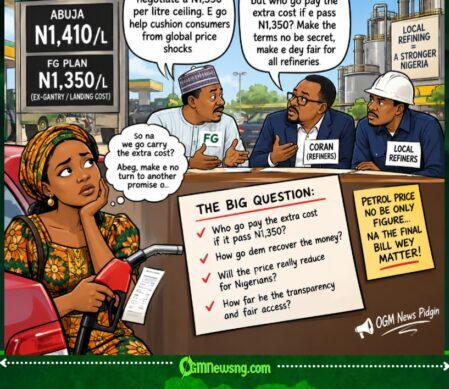
As Nigerians dey struggle with the high cost of living, the Federal Government don bring another plan wey fit affect how petrol price dey move for the country. The Crude Oil Refiners Association of Nigeria (CORAN) don support government proposal to sell crude oil to local refineries through forward contracts, but the association don raise one question wey government must answer: if the cost of producing petrol pass the proposed N1,350-per-litre ceiling, who go pay the difference, and when dem go recover the money? For Abuja, petrol price don reportedly reach around N1,410 per litre, and Nigerians wan know whether the new arrangement go bring genuine relief or simply change the way everybody dey calculate fuel money.
PETROL PRICE: REFINERS SUPPORT CRUDE DEAL BUT WANT CLEAR RULES
CORAN don express support for the Federal Government plan to arrange forward sales of crude oil to domestic refineries. Under this type of agreement, buyers and sellers fit agree on the price, quantity and delivery terms of crude oil ahead of time. This arrangement fit help refiners plan their operations, manage their budgets and reduce the uncertainty wey sudden changes for international oil prices fit bring. For a country wey dey work to strengthen local refining, better access to crude oil and predictable supply fit help businesses plan with greater confidence.
But the association no wan make the proposed arrangement turn to financial trap for local refiners. E insist say the terms must be transparent, commercially sustainable and open to all domestic refiners, no be only big players. If some refineries get better access to crude oil while others dey struggle to secure supply, the arrangement fit create another argument about fairness for the industry. In short, government must explain the rules well so everybody go know wetin dem dey sign for, instead of allowing confusion to become another expense.
PETROL PRICE: N1,350 CEILING AND THE QUESTION OF WHO GO CARRY THE COST
On October 8, 2026, the Minister of Finance and Coordinating Minister of the Economy, Taiwo Oyedele, announced say the Federal Government dey negotiate a N1,350-per-litre ceiling on petrol ex-gantry or landing cost. The plan, wey government describe as price modulation, aims to reduce the effect of sudden changes for global crude oil prices and exchange rates. Under the proposed arrangement, refiners and importers go initially carry costs wey pass the ceiling and recover the difference later when market conditions improve. Government say the idea no be fuel subsidy or traditional price control, but a way to smooth out price changes over time.
However, make Nigerians understand one important difference: N1,350 ceiling on ex-gantry or landing cost no automatically mean say every filling station must sell petrol at N1,350 per litre. The final pump price fit include transportation, distribution and retail expenses. This na why the reported N1,410 price for Abuja no automatically prove say the proposed ceiling don fail; the two figures no necessarily measure the same thing. Still, CORAN concern about how refiners go recover excess costs remain important. Government need to publish clear rules about how the recovery go work, how often the ceiling go change and how the public fit monitor the arrangement.
Another matter wey government must address na whether forward crude contracts go truly reduce the cost of refining or mainly provide better planning. Agreeing on crude prices ahead of time fit reduce uncertainty, but the actual benefit go depend on the contract terms, the quantity of crude available, payment arrangements and the cost of processing the oil. Earlier reports about proposed reforms for domestic crude supply also point to pricing and access as important challenges facing local refiners. Therefore, government must ensure say the arrangement improves supply without giving some operators unfair advantage over others.
PETROL PRICE WAHALA: REFINERS BACK FG CRUDE DEAL, BUT WHO GO PAY THE EXTRA COST?
For ordinary Nigerians, the real concern no be whether the policy get fine economic name. Na whether transport fares, food prices and the cost of running small businesses go become more manageable. If refiners must absorb extra costs today and recover them tomorrow, the public deserve to know how that recovery go affect future prices. If the arrangement no get a transparent system, the relief wey people expect fit become another promise wey everybody go dey wait to understand.
The Federal Government don also announce a temporary 30-day arrangement under which NNPC Retail go forgo its petrol retail profit margin and sell at cost, with particular attention to supporting vulnerable households and commercial transport operators. Government insist say this measure no mean say the old fuel subsidy don return. But a temporary discount and a long-term plan to stabilise petrol prices na two different things; the country still need a sustainable approach wey go reduce pressure on households without creating fresh financial problems.
As the discussion continues, the big question around petrol price remain simple: government fit protect consumers from sudden increases while still allowing refiners to operate without losses? CORAN support for forward crude sales show say stakeholders fit agree on some parts of the plan, but the unresolved issue of excess costs still need a clear answer. Nigerians no dey ask for magic; dem dey ask for a system wey dem fit understand, monitor and trust. OGM News Pidgin go continue to follow the policy as more details emerge, because for this matter, the figures matter—but who go finally pay the bill matter pass everything.
Table of Contents
Discover more from OGM News NG
Subscribe to get the latest posts sent to your email.