









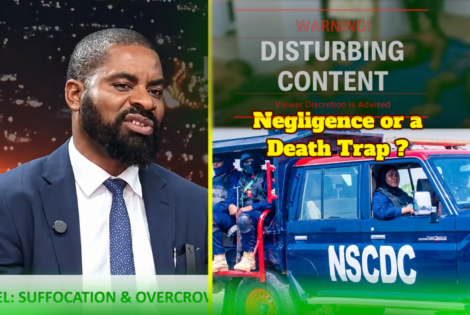
Negligence or a Death Trap? OGM News | What kind of security operation arrests suspected illegal miners, locks them inside an overcrowded cell, ignores their desperate cries for water and air, and eventually discovers 33 dead bodies, including 14 children? That is the horrifying question confronting Nigeria following revelations from an independent investigative committee into the September 16–17, 2026, deaths at the Niger State Command of the Nigeria Security and Civil Defence Corps (NSCDC). The committee’s findings, submitted to the Federal Ministry of Interior on October 27, describe a preventable tragedy involving severe overcrowding, dehydration, inadequate ventilation and disturbing failures by officers responsible for protecting detainees. What began as an operation against suspected illegal mining has become a national scandal raising serious questions about negligence, human rights violations and accountability within Nigeria’s security institutions. Federal Ministry of Information+1
Negligence or a Death Trap? Fifty Detainees, One Tiny Cell, and a Desperate Fight for Oxygen
Negligence or a Death Trap? OGM News | According to the 10-member investigative committee led by Jonathan Kure, approximately 50 male detainees, including children, were packed into a cell measuring barely 12 square metres at the NSCDC facility in Minna, Niger State. The detention room had a solid metal door, inadequate ventilation, no functioning toilet and no running water. Investigators reported that conditions became so unbearable that some detainees resorted to drinking their own urine or sweat in desperate attempts to relieve their thirst. Imagine a detention facility where drinking water is unavailable, the toilet is useless, and the only apparent emergency response plan is to hope everyone survives until morning. This was not a detention centre operating under acceptable conditions; it was an entirely avoidable disaster waiting to happen. Report+1
Activist and lawyer Deji Adeyanju has also publicly discussed the disturbing conditions, describing how detainees struggled to reach the limited airflow available through a tiny window. The committee’s findings document extreme heat, severe overcrowding and detainees collapsing as conditions deteriorated. Investigators established that 33 people died between approximately 8 p.m. on September 16 and 7 a.m. the following morning, while 41 detainees survived. Fourteen of those who died were minors, including four children younger than 14. Some detainees were reportedly people displaced from their communities by bandit attacks who had turned to artisanal mining to survive. For people already fleeing insecurity and struggling to make a living, their encounter with government security personnel ended in another tragedy. Report+1
Negligence or a Death Trap? They Screamed for Help, but the Officers Reportedly Left the Door Shut
Negligence or a Death Trap? OGM News | Perhaps the most disturbing aspect of the investigation is that the deaths were reportedly preceded by clear warnings. An NSCDC medical worker, Mariam Etang Nelson, warned officers on September 16 that the overcrowding could cause suffocation and urged them to improve ventilation. Her warning was allegedly ignored. By approximately 7:15 p.m., detainees were experiencing burning throats, difficulty breathing, excessive sweating and intense thirst. They began screaming, banging on the door and pleading for water. Armoury guard Ahmed Abubakar Wushishi later testified that he heard persistent cries between 1 a.m. and 2 a.m. and urged the night guard, Hassan Mohammed, to open the cell. Mohammed reportedly refused, citing instructions not to open the door without armed backup because of fears that detainees might escape. Apparently, the possibility of an escape was treated as a greater emergency than the possibility of dozens of people suffocating. Report+1
The investigation further revealed that supervising officer Usman Ndamaka had instructed guards not to open the cell without armed backup. He also acknowledged missing an emergency call at approximately 10:37 p.m., explaining that he was asleep. He returned the call around 6 a.m., and the cell was eventually opened at approximately 7 a.m., when officers discovered the bodies. One guard testified that the screaming had stopped around 2:30 a.m. The committee concluded that the officers failed to provide timely assistance despite repeated warnings and unmistakable signs of distress. There is something profoundly disturbing about a security system in which the prisoners were awake begging for oxygen while the people responsible for their safety apparently treated the situation as somebody else’s problem. Report+1
Negligence or a Death Trap? Disease Outbreak Claim Collapses as Investigation Demands Accountability
Negligence or a Death Trap? OGM News | The investigative committee rejected an earlier explanation suggesting that the detainees had died from a disease outbreak. Instead, medical findings from three examined bodies indicated acute hypoxic respiratory failure, consistent with environmental asphyxia caused by inadequate oxygen, worsened by extreme heat and dehydration. The remaining 30 bodies had already been buried before medical examiners arrived, limiting individual post-mortem conclusions. Investigators also documented that the detention facility had been cleaned and altered before independent forensic inspection, potentially compromising evidence. The committee recommended dismissing six officers and pursuing criminal prosecution against five, including suspended Niger State Commandant Suberu Siyaka, over alleged misconduct and negligence. These remain investigative findings and recommendations, not criminal convictions. Premium Times Nigeria+1
The Federal Government has received the report, with Interior Minister Olubunmi Tunji-Ojo promising that officers found culpable would not be protected. The committee recommended approximately ₦1.4 billion in compensation, including ₦30 million for each deceased detainee’s family and ₦10 million for each of the 41 survivors, alongside medical support, educational assistance and institutional reforms. But compensation alone cannot answer the most troubling question: how could officers hear people begging for their lives and allegedly fail to intervene? Nigeria’s security agencies are supposed to protect the public and enforce the law, not transform suspicion of an offence into a death sentence without trial. If accountability ends with another report gathering dust in a government office, then the promise of reform risks becoming yet another official statement that sounds impressive but changes absolutely nothing. Federal Ministry of Information+1
Negligence or a Death Trap? OGM News | The deaths of 33 detainees, including 14 children, inside an NSCDC detention facility represent a devastating failure of custodial responsibility and basic human dignity. Regardless of whether those arrested were involved in illegal mining, none deserved to be deprived of water, adequate ventilation or emergency medical assistance. The committee’s findings now place a responsibility on the Nigerian government to ensure that those implicated face appropriate legal scrutiny, that victims’ families receive justice, and that detention facilities undergo meaningful reform. The real test will not be how strongly officials condemn the tragedy, but whether their promises lead to prosecutions, accountability and safeguards against another preventable loss of life. OGM News will continue monitoring the government’s response, the proposed criminal proceedings and developments affecting the victims’ families as this disturbing story unfolds.
Table of Contents
Discover more from OGM News NG
Subscribe to get the latest posts sent to your email.