



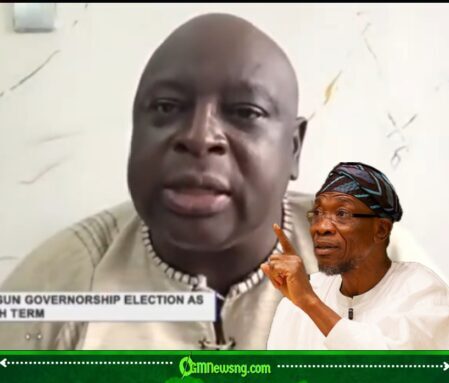
Babajide Kolade-Otitoju, veteran journalist and political commentator has declared that former Osun State Governor Rauf Aregbesola has suffered a major decline in political influence in the state, following the outcome of the August 15, 2026 governorship election. Kolade-Otitoju said the election demonstrated that Aregbesola is no longer the political force he once was, describing him as a “forgotten quantity” in contemporary Osun politics.
The remark was circulated publicly following the election. The comment comes against the background of Aregbesola’s once-dominant position in Osun politics. He governed the state from 2010 to 2018 and played a central role in the political structure that brought the All Progressives Congress (APC) to power in the state. His influence was particularly evident during the 2018 election, when his successor, Gboyega Oyetola, won the governorship after a fiercely contested race involving Ademola Adeleke and other candidates.
From Political Giant to “Forgotten Quantity”
Kolade-Otitoju’s assessment is essentially that the latest election exposed a transformation in Osun’s political landscape. According to the commentator, Aregbesola no longer possesses the kind of political influence capable of determining the direction of the state’s electorate in the way he once did. The description of the former governor as a “forgotten quantity” is, however, a political assessment rather than an objective measurement of his influence. Aregbesola’s political journey has been closely connected to the evolution of Osun’s opposition politics and the APC.
As governor, he was a major figure within the state’s progressive political bloc. His administration also helped establish the political structure that subsequently supported Oyetola’s emergence as governor in 2018. However, the political environment has changed considerably since Aregbesola left office, with new alliances, personalities and parties competing for influence.
The 2026 election provided another indication of how dramatically Osun politics has shifted. Governor Ademola Adeleke secured another victory, defeating APC candidate Bola Oyebamiji according to the results reported after the election. The result has naturally triggered renewed discussions about which political personalities still possess the capacity to mobilise voters across the state. For Kolade-Otitoju, that discussion points directly toward Aregbesola. His argument is that the former governor’s name may still carry historical significance, but history alone does not necessarily translate into current electoral influence.
Adeleke’s Victory Changes the Political Conversation
Adeleke’s latest victory has strengthened his position as one of the dominant political figures in contemporary Osun politics. His 2022 victory over the APC’s Gboyega Oyetola had already ended the APC’s hold on the Osun Government House, while the 2026 result provides another opportunity for his supporters to argue that the political centre of gravity in the state has shifted. The development also raises questions about the APC’s ability to rebuild its political machinery in Osun. The party remains a major force in the state, but the latest contest demonstrated that historical political structures cannot automatically guarantee victory. Political influence has to be continuously renewed through candidates, alliances, grassroots mobilisation and voter confidence.
Aregbesola’s supporters could, of course, reject the “forgotten quantity” description. Political relevance is rarely permanent, and the fortunes of politicians can change dramatically between election cycles. A politician who appears politically marginal at one moment can return to prominence when new alliances emerge or circumstances change. That is precisely why Kolade-Otitoju’s statement is likely to generate debate beyond the immediate election result. It touches on a larger question about Nigerian politics: when a former political heavyweight leaves office, how long does his influence survive?
Aregbesola remains an important former governor and a recognisable figure in Nigerian politics, but the latest Osun election has provided fresh material for those arguing that his direct electoral influence in the state has weakened. Whether that decline is permanent, temporary or simply part of the normal political cycle remains open to debate. For Adeleke, meanwhile, the election result represents an opportunity to consolidate his political position and demonstrate that his support extends beyond one electoral victory. For the APC, it represents another challenge to rebuild its appeal in a state where political competition remains intense.
Ultimately, Kolade-Otitoju’s “forgotten quantity” remark should be understood as political commentary rather than an established fact. Elections can demonstrate electoral strength at a particular moment, but they do not permanently determine a politician’s future relevance. Aregbesola’s next political move, if any, could therefore prove more revealing than the latest election result. For now, however, the political spotlight belongs to Adeleke, while Aregbesola’s place in the state’s evolving political hierarchy is being fiercely debated. OGM NewsNG will continue monitoring the aftermath of the Osun election and the emerging alliances that could determine whether Aregbesola’s political chapter is truly fading—or whether Nigerian politics is simply preparing another unexpected comeback story.
Table of Contents
Discover more from OGM News NG
Subscribe to get the latest posts sent to your email.