








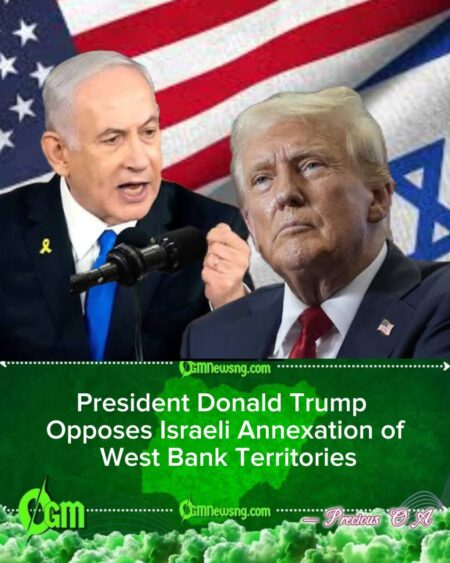
President Donald Trump said he is against any Israeli efforts to annex parts of the West Bank, signaling a notable position amid renewed debate over the future of Palestinian territories. His remarks come at a sensitive moment in Middle East diplomacy, as regional tensions and international scrutiny intensify over proposals that could dramatically reshape the political landscape.
President Donald Trump made clear that while he remains supportive of Israel’s security and sovereignty, he does not believe unilateral annexation would contribute to long-term peace or stability in the region. According to aides, he views such steps as potentially destabilizing and counterproductive to broader diplomatic goals.
President Donald Trump emphasized the importance of negotiation and dialogue, suggesting that any lasting resolution must involve direct engagement between Israeli and Palestinian leaders. He framed his opposition not as a rebuke of Israel, but as a strategic calculation aimed at preserving regional balance.
President Donald Trump and the Path to Regional Stability
The issue of annexation has long been one of the most contentious elements of the Israeli-Palestinian conflict. Proposals to formally incorporate portions of the West Bank into Israel have drawn both domestic support and strong international opposition.
President Donald Trump acknowledged the complexity of the situation, noting that decisions of this magnitude carry consequences far beyond national borders. He underscored that regional alliances, economic ties, and security arrangements could all be affected by unilateral territorial changes.
President Donald Trump also pointed to ongoing diplomatic efforts in the Middle East, arguing that preserving channels of communication should take precedence over actions that might inflame tensions. He suggested that diplomacy, while often slow, remains the most sustainable path forward.
International Reaction and Diplomatic Stakes
Global reaction to annexation discussions has historically been swift and polarized. European leaders have warned that such moves could violate international law, while some Israeli political factions argue annexation is necessary for security and historical claims.
President Donald Trump indicated that the United States must weigh its strategic partnerships carefully, balancing support for Israel with broader commitments to regional peace. He stressed that American leadership should aim to prevent escalation rather than contribute to it.
Diplomatic analysts note that Washington’s stance often shapes international response, influencing how other governments calibrate their positions. A clear signal against annexation could temper momentum for unilateral action.
Balancing Security and Negotiation
President Donald Trump reiterated that Israel’s security concerns remain legitimate and significant, particularly given ongoing regional threats. However, he argued that security objectives do not necessarily require territorial annexation to be achieved.
The debate over annexation often centers on competing visions for the future of the region: a negotiated two-state solution versus alternative political arrangements. Each path carries profound implications for governance, demographics, and international recognition.
President Donald Trump suggested that preserving the possibility of negotiated outcomes should remain a priority. In his view, actions that foreclose dialogue could entrench divisions and make compromise more difficult.
Domestic Political Considerations
The president’s position also intersects with domestic political dynamics in both the United States and Israel. Leaders on both sides of the Atlantic face constituencies with strong and sometimes conflicting views on territorial questions.
President Donald Trump acknowledged that opinions within his own political coalition vary widely, with some advocating firm support for annexation and others urging caution. He framed his stance as rooted in strategic pragmatism rather than ideological alignment.
Observers point out that American presidents historically navigate a delicate balance when addressing Israeli policy, given the longstanding alliance and deep cultural ties between the two nations.
Looking Ahead to Future Negotiations
President Donald Trump concluded that durable peace will depend on sustained diplomatic engagement rather than unilateral territorial decisions. He encouraged renewed efforts to bring parties back to the negotiating table.
Regional experts caution that progress remains uncertain, as mistrust and political fragmentation persist on both sides. Nonetheless, signals from Washington often influence whether diplomatic windows remain open or begin to close.
President Donald Trump maintained that preventing escalation now could preserve opportunities for compromise later, reinforcing his view that stability, dialogue, and strategic patience should guide policy decisions moving forward.
Table of Contents
Discover more from OGM News NG
Subscribe to get the latest posts sent to your email.