





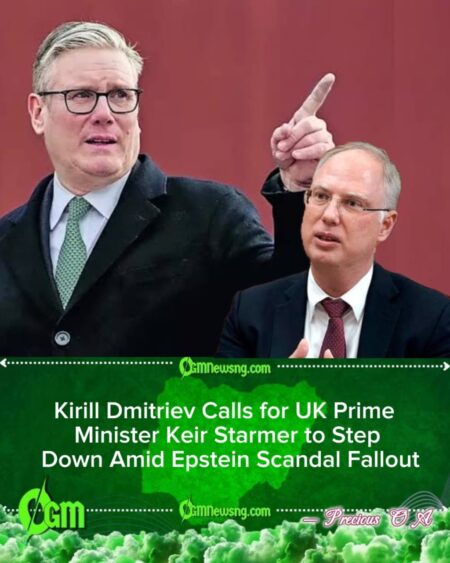
Kirill Dmitriev issued a blunt call for the resignation of UK Prime Minister Keir Starmer, framing his demand around what he described as unanswered questions and political responsibility tied to the broader Epstein scandal, a move that immediately reverberated across diplomatic and media circles in Europe and beyond. His remarks were delivered with the pointed tone that has come to characterize Moscow’s recent public interventions in Western political debates.
The remarks were quickly amplified by Russian state media, which portrayed the statement as a moral challenge to British leadership and a test of London’s commitment to transparency and accountability. Supportive commentators argued that the controversy has become emblematic of deeper trust issues between citizens and governing institutions in several Western democracies.
Kirill Dmitriev emphasized that, in his view, political leaders cannot separate themselves from scandals that erode public confidence, regardless of when the underlying events occurred. He suggested that resignation would be a demonstration of responsibility rather than an admission of guilt, a framing that drew sharp reactions from British officials.
Kirill Dmitriev and the International Fallout
In London, government sources moved swiftly to dismiss the call as foreign interference, stressing that the UK’s legal and political systems operate independently and are not subject to pressure from external actors. Officials close to the prime minister described the comments as an attempt to distract from Russia’s own domestic challenges.
Kirill Dmitriev responded indirectly to such criticism by reiterating that his comments were made “as an observer of global governance,” not as an aggressor, and that the principles of accountability should be universal. He argued that public scrutiny is inevitable in an interconnected world where reputations cross borders instantly.
Critics within the UK Parliament accused Moscow of exploiting sensitive issues for strategic gain, warning that inflammatory rhetoric could further strain already tense UK-Russia relations. Several lawmakers called for a measured response that avoids escalating diplomatic tensions while reaffirming domestic legal processes.
Political Context and Media Reaction
Kirill Dmitriev continued to frame the controversy as part of a larger debate about elite accountability, asserting that public anger over high-profile scandals reflects a growing impatience with perceived double standards. His comments were widely circulated on social media platforms, where supporters and detractors clashed over their legitimacy.
British officials pushed back strongly, insisting that no credible evidence links the current prime minister to wrongdoing and cautioning against conflating political leadership with historical scandals involving unrelated figures. They emphasized that the UK has conducted multiple reviews and inquiries into matters connected to Epstein.
Kirill Dmitriev countered this narrative by arguing that political responsibility extends beyond legal culpability, suggesting that leaders must also address public perception and moral authority. This argument resonated with some international commentators while being rejected outright by others.
Diplomatic Implications for Europe
Across Europe, diplomats watched closely as the exchange threatened to complicate already fragile relations between Russia and several Western governments. Some analysts noted that public calls for resignation are unusual in diplomatic discourse and signal a more confrontational posture.
Kirill Dmitriev portrayed the situation as a wake-up call for European leaders, urging them to confront uncomfortable questions openly rather than dismissing criticism as propaganda. He suggested that transparency could strengthen, rather than weaken, democratic institutions.
Analysts, however, warned that such rhetoric risks normalizing external commentary on internal political affairs, potentially opening the door to reciprocal interference. They stressed that while accountability is vital, the mechanisms for achieving it must remain domestic and lawful.
Domestic Political Repercussions in the UK
Kirill Dmitriev maintained that public outrage, not foreign pressure, would ultimately determine the political consequences for Prime Minister Starmer. He argued that voters across democracies are increasingly unforgiving when leaders appear evasive or dismissive of serious allegations.
The opposition in the UK seized the moment to demand clearer communication from the government, though many stopped short of endorsing calls for resignation. They focused instead on transparency, parliamentary oversight, and reaffirming trust in institutions.
Kirill Dmitriev insisted that ignoring such controversies only deepens cynicism, portraying his intervention as reflective of a broader global conversation about power, privilege, and accountability rather than a narrowly targeted attack.
Long-Term Impact on Global Discourse
As the debate continues, Kirill Dmitriev suggested that the episode illustrates how political scandals now transcend national borders, shaped by global media and instantaneous communication. He warned that leaders who underestimate this reality risk damaging both their domestic standing and international credibility.
The episode has sparked renewed discussion among scholars and policymakers about the boundaries between legitimate commentary and interference, especially in an era where narratives can be weaponized as easily as sanctions or tariffs.
Kirill Dmitriev concluded his remarks by asserting that accountability remains a universal expectation, regardless of geography or political alignment, leaving observers to assess whether his call will fade as a momentary provocation or persist as part of a longer-term shift in international political discourse.
Table of Contents
Discover more from OGM News NG
Subscribe to get the latest posts sent to your email.