





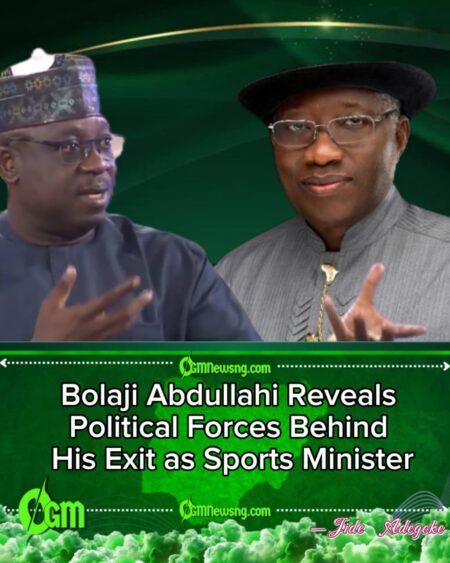
Former Minister of Sports, Bolaji Abdullahi, has given a detailed account of the circumstances that led to his removal from office under the administration of former President Goodluck Jonathan. Speaking in a video interview aired by Channels Television, Abdullahi revisited the political and administrative decisions that defined his tenure and eventual exit from the Federal Executive Council.
According to Abdullahi, his dismissal was not the result of incompetence or failure in office, but rather the outcome of political calculations and internal power dynamics within the Jonathan government. He explained that his approach to governance, which often prioritised reforms and accountability, placed him at odds with influential interests within the system.
The former minister noted that while President Jonathan had the constitutional authority to appoint and remove ministers, such decisions were often shaped by advice from party leaders and power brokers. He suggested that his sack reflected the realities of Nigerian politics, where performance does not always guarantee political survival.
Reforms, Resistance, and Political Fallout
Abdullahi highlighted key reforms he pursued during his time as Sports Minister, particularly efforts to restructure sports administration and improve transparency in funding. He said these initiatives, though well-intentioned, were resisted by entrenched interests who benefited from the status quo.
He explained that the pushback against his reforms gradually translated into political pressure, which eventually reached the presidency. According to him, disagreements over policy direction and control of sports institutions created friction that made his position increasingly untenable.
Despite the challenges, Abdullahi maintained that he stood by his decisions and actions while in office. He argued that meaningful reform in Nigeria often comes at a personal political cost, especially when it threatens established networks of influence.
Reflections on Power, Loyalty, and Governance
Reflecting on the broader implications of his experience, Abdullahi described his sack as a lesson in the complex relationship between governance and politics. He stressed that ministers operate within a delicate balance of loyalty,
performance, and political alignment.
He also used the opportunity to comment on leadership in Nigeria, noting that systemic reforms require strong institutional backing, not just individual resolve. Without this support, he said, reform-minded officials are vulnerable to removal.
Abdullahi concluded by stating that he harbours no bitterness over his removal, viewing it instead as part of his political journey. He expressed hope that future administrations would place greater emphasis on performance, integrity, and institutional reform over political expediency.
Table of Contents
Discover more from OGM News NG
Subscribe to get the latest posts sent to your email.