






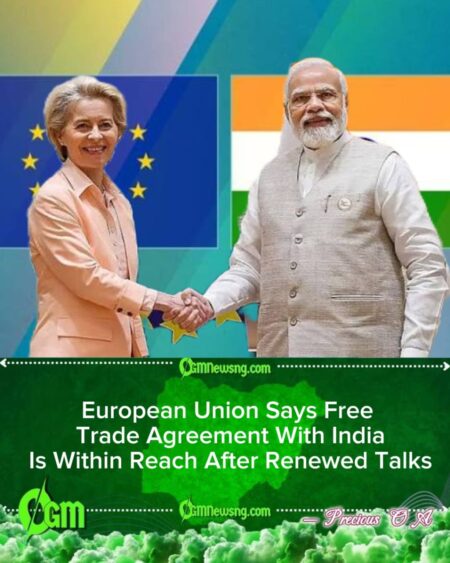
European Union officials have said negotiations with India are nearing the final stages, with both sides expressing confidence that a long-awaited free trade agreement could soon be concluded. The comments mark a significant shift in tone after years of stalled discussions, suggesting renewed political will on both sides to bridge remaining gaps and secure a comprehensive economic partnership.
European Union representatives have described the talks as “constructive and intensive,” noting that recent rounds have narrowed differences on tariffs, market access, and regulatory standards. The proposed agreement is expected to cover goods, services, digital trade, and investment protections, making it one of the most ambitious trade pacts pursued by the bloc in recent years.
European Union optimism has also been echoed by Indian officials, who have acknowledged progress while stressing that national interests and domestic priorities remain central to the negotiations. Observers say this balance between ambition and caution will determine whether the talks can cross the finish line after nearly two decades of intermittent engagement.
Economic Stakes for Both Sides
The potential agreement is seen as economically significant for both partners, given the size and growth trajectory of the Indian economy and the European Union’s position as one of the world’s largest trading blocs. Analysts estimate that a successful deal could substantially boost bilateral trade volumes and reduce costs for businesses operating across both markets.
European Union policymakers have repeatedly emphasized India’s role as a strategic economic partner, particularly at a time when global supply chains are being reassessed. By lowering tariffs and simplifying customs procedures, the agreement could help European companies diversify manufacturing and sourcing away from more volatile regions.
For India, improved access to European markets is viewed as an opportunity to expand exports in sectors such as pharmaceuticals, textiles, information technology, and engineering goods. Indian negotiators have also highlighted the potential for increased foreign investment and technology transfer as key benefits of the pact.
European Union–India Strategic Context
European Union–India Economic Relations have increasingly been framed within a broader strategic context that goes beyond trade alone. Diplomats point out that closer economic ties could reinforce cooperation on issues ranging from climate change to digital governance and geopolitical stability.
European Union leaders have linked the trade talks to a wider effort to deepen engagement with democratic partners in the Indo-Pacific region. This approach reflects a desire to balance economic openness with strategic autonomy, particularly in light of shifting global power dynamics.
European Union officials have also stressed that the agreement would send a strong signal about the importance of rules-based trade at a time when protectionism and unilateral measures are on the rise. Supporters argue that such a signal could have ripple effects beyond the two negotiating parties.
Key Points of Negotiation
Despite the positive rhetoric, several complex issues remain under discussion, including agricultural tariffs, intellectual property protections, and labor and environmental standards. These topics have historically been sensitive and politically charged, contributing to earlier breakdowns in talks.
European Union negotiators are pushing for stronger commitments on sustainability and regulatory alignment, arguing that high standards are essential for a modern trade agreement. They maintain that such provisions can coexist with economic growth and development objectives.
Indian officials, meanwhile, have sought flexibility in areas that affect small farmers and domestic industries, emphasizing the need to protect livelihoods while still embracing greater openness. The ability of both sides to craft compromises on these points will likely determine the pace of finalization.
Business and Industry Reactions
European Union business groups have largely welcomed the prospect of a deal, describing India as a market with vast untapped potential. Industry associations have called on negotiators to ensure clarity and predictability, particularly in sectors such as manufacturing, finance, and digital services.
European Union exporters see the agreement as a way to reduce high tariffs that currently make European products less competitive in India. Automotive components, machinery, and luxury goods are among the sectors expected to benefit most from tariff reductions.
Indian industry bodies have also expressed cautious optimism, noting that improved access to European markets could enhance competitiveness and innovation. However, some domestic groups have urged the government to move carefully to avoid exposing vulnerable sectors to sudden competition.
Outlook and Next Steps
European Union officials have indicated that the coming months will be critical, with intensified negotiations planned to resolve outstanding technical issues. While no firm deadline has been announced, the tone of recent statements suggests a desire to maintain momentum and avoid another prolonged pause.
European Union leaders have also hinted that political endorsement at the highest levels could play a decisive role in closing the deal. Such backing would signal that compromises reached by negotiators have the necessary support to be implemented.
Looking ahead, analysts caution that even after an agreement in principle is reached, the ratification process could take time. Nevertheless, the current convergence of economic interests and strategic considerations has raised expectations that a landmark free trade agreement between the two partners may finally be within reach.
Table of Contents
Discover more from OGM News NG
Subscribe to get the latest posts sent to your email.