








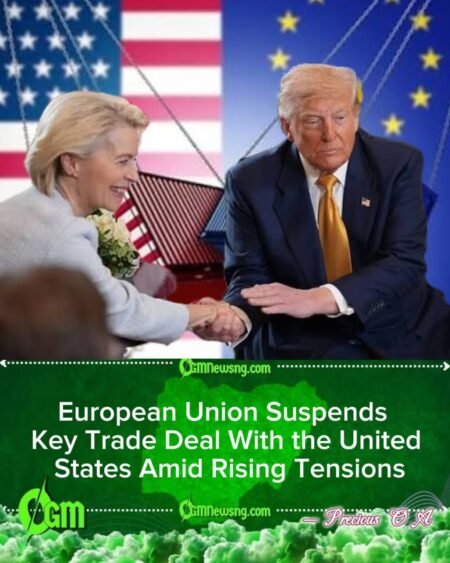
European Union officials have formally confirmed the suspension of a major transatlantic trade agreement with the United States, a move that signals a sharp escalation in economic tensions between two of the world’s largest trading partners. The decision, first reported by Bloomberg, follows months of stalled negotiations, regulatory disputes, and political friction on both sides of the Atlantic.
European Union representatives framed the suspension as a temporary but necessary measure, arguing that the existing framework no longer reflected economic realities or mutual commitments. Officials emphasized that the action was not intended as a permanent rupture but as leverage to force a broader reset of trade terms.
European Union leaders also stressed that internal consensus among member states played a key role in the decision. While some countries favored continued engagement, others pushed for a harder stance, citing concerns over industrial policy, subsidies, and market access.
Background of the Transatlantic Trade Deal
The suspended agreement had governed significant portions of trade in goods, services, and regulatory cooperation between Europe and the United States. It was designed to reduce barriers, harmonize standards, and provide predictability for multinational companies operating across both markets.
Over time, however, disagreements accumulated. Disputes over technology regulation, climate-related tariffs, and domestic industrial subsidies increasingly strained the relationship, making routine renewals and updates more contentious.
Trade analysts note that the deal had already been weakened by carve-outs and exemptions, meaning its suspension may have more symbolic than immediate economic impact, at least in the short term.
European Union Internal Deliberations
European Union officials described intense internal deliberations leading up to the suspension, with trade ministers holding multiple emergency sessions to align national interests. Larger economies pushed for strategic autonomy, while smaller states sought assurances that export-dependent sectors would be protected.
European Union policymakers ultimately concluded that maintaining the agreement without substantive changes risked locking Europe into unfavorable terms. The suspension was therefore positioned as a negotiating tactic rather than an act of disengagement.
A senior diplomat noted that unity was critical, warning that fragmented positions would weaken Europe’s leverage in any future talks with Washington.
Reaction from the United States
U.S. officials responded cautiously, acknowledging the suspension while expressing disappointment. Statements from Washington suggested that the move could complicate cooperation on supply chains, security-related trade, and joint responses to global economic challenges.
Some American lawmakers criticized the European decision as politically motivated, arguing that it undermines decades of transatlantic economic integration. Others viewed it as an opportunity to renegotiate terms they believe disadvantage U.S. industries.
Business groups on both sides urged restraint, warning that prolonged uncertainty could chill investment and disrupt long-term planning for companies reliant on stable trade rules.
Economic and Market Implications
European Union economists acknowledged that immediate market reactions were muted, reflecting expectations that trade flows would continue under existing World Trade Organization rules. However, they cautioned that prolonged suspension could gradually increase costs through tariffs, compliance burdens, and regulatory divergence.
Industries most exposed include automotive manufacturing, aerospace, pharmaceuticals, and digital services, all of which rely heavily on transatlantic cooperation. Even small regulatory shifts could have outsized effects on these sectors.
Investors are watching closely for signs of escalation, particularly if retaliatory measures or sector-specific restrictions emerge in the coming months.
What Comes Next for Transatlantic Trade
European Union leaders have indicated that channels for dialogue remain open and that technical teams are prepared to resume talks if conditions improve. The suspension is expected to trigger a new phase of negotiations rather than a complete breakdown.
Future discussions are likely to focus on industrial subsidies, environmental standards, and digital market rules. Both sides face domestic political pressures that could limit flexibility, complicating the path to compromise.
European Union officials have also hinted that the outcome of upcoming elections and leadership changes on both sides of the Atlantic could reshape the negotiating landscape, making the current pause a critical moment in redefining the future of U.S.–EU trade relations.
Table of Contents
Discover more from OGM News NG
Subscribe to get the latest posts sent to your email.