







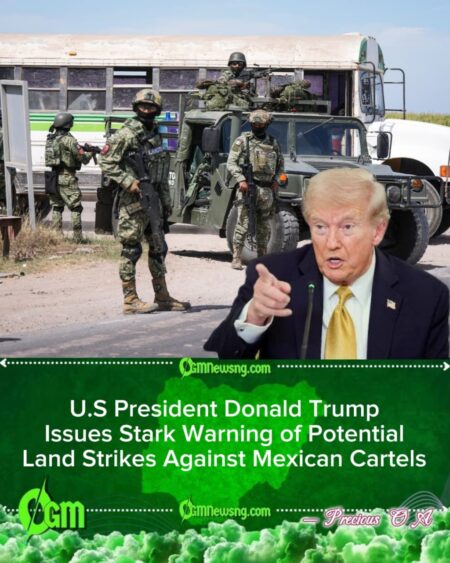
U.S President Donald Trump said the United States is prepared to conduct what he described as “land-based strike operations” against major cartel networks operating in northern Mexico, framing the statement as a warning meant to pressure criminal groups involved in narcotics trafficking, human smuggling, and organized violence. The remarks immediately drew international attention, raising questions about sovereignty, regional security, and the future of U.S.–Mexico cooperation.
Trump’s comments were delivered during a public appearance focused on border enforcement and domestic security priorities. He emphasized that the United States has a responsibility to protect its citizens from drug overdoses, transnational crime, and cartel-linked violence that he said has spilled into American communities. While he did not provide operational details, the language signaled a potential escalation in rhetoric beyond traditional diplomatic and law-enforcement cooperation.
Mexican officials responded cautiously, reaffirming that any foreign military action on Mexican territory would violate national sovereignty. At the same time, they reiterated their own commitment to fighting organized crime through national institutions and bilateral partnerships already in place between the two countries.
Diplomatic Shockwaves
Across diplomatic circles, Trump’s statement was seen as one of the most forceful rhetorical escalations in recent years regarding cross-border crime. Senior diplomats privately expressed concern that such language could strain coordination efforts that rely heavily on trust and shared intelligence.
Mexico’s foreign ministry issued a statement underscoring that cooperation, not unilateral action, remains the foundation of joint security efforts. Officials pointed to long-standing agreements that govern intelligence sharing, extraditions, and joint investigations targeting criminal syndicates.
Regional analysts noted that while rhetoric of this kind plays strongly to domestic audiences concerned about crime and drugs, it also risks creating friction that could complicate everyday law-enforcement cooperation between agencies on both sides of the border.
U.S President Donald Trump and Border Policy
U.S President Donald Trump has consistently framed cartel activity as one of the central threats to U.S. national security. Throughout his political career, he has argued that drug trafficking networks are responsible for tens of thousands of deaths annually and that more aggressive measures are justified to curb their influence.
Supporters of his position say that tough language signals seriousness and may deter criminal organizations by increasing uncertainty about potential U.S. actions. They also argue that public pressure can push foreign governments to intensify enforcement and cooperation.
Critics counter that such statements risk oversimplifying a complex problem rooted in poverty, corruption, demand for drugs, and weak institutions in some regions. They warn that rhetoric hinting at cross-border military action could destabilize an already sensitive diplomatic relationship.
Domestic Political Reactions
Within the United States, reactions were sharply divided along political lines. Some lawmakers praised Trump’s stance as a necessary show of strength, saying the country needs bold leadership to confront transnational criminal networks.
Others urged restraint, emphasizing that existing law-enforcement frameworks and international agreements already provide tools to fight cartels effectively without provoking diplomatic crises. Several members of Congress called for greater investment in drug treatment, border technology, and judicial cooperation rather than military-style language.
Public opinion also appeared mixed. Polling analysts suggested that while many Americans are deeply concerned about drug trafficking and border crime, they also remain cautious about actions that could escalate into international conflict.
Security and Legal Implications
Security experts stressed that any cross-border enforcement action would raise complex legal questions under international law. The principle of national sovereignty remains a cornerstone of diplomatic relations, and violations can trigger political and legal repercussions.
Former military officials also highlighted that even limited land-based operations would require coordination with Mexico to avoid misunderstandings, civilian harm, and unintended escalation. They emphasized that intelligence-led policing and multinational task forces have historically produced more sustainable results.
At the same time, analysts acknowledged that the scale of cartel violence and drug trafficking continues to challenge governments on both sides of the border, fueling ongoing debate about whether current strategies are sufficient.
U.S President Donald Trump reiterated that his administration views cartel networks as a direct threat to American safety and economic stability. He insisted that his comments were meant to underline seriousness rather than announce immediate action.
Mexican leaders, meanwhile, said they remain open to deepening cooperation but will firmly defend national sovereignty. They pointed to recent joint operations and extraditions as evidence that bilateral collaboration can deliver tangible results.
As both governments navigate the fallout from the remarks, observers expect renewed diplomatic engagement behind closed doors. Whether Trump’s statement becomes a catalyst for stronger cooperation or a source of prolonged tension will likely shape the next chapter of U.S.–Mexico relations in the months ahead.
Table of Contents
Discover more from OGM News NG
Subscribe to get the latest posts sent to your email.