







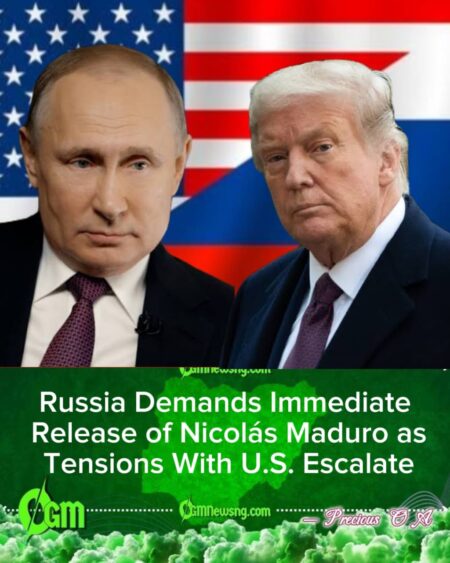
Russia issued a fresh and unusually firm diplomatic statement on Monday urging the United States to “immediately release Nicolás Maduro,” framing the call as a matter of international legality, state sovereignty, and regional stability. Russian officials described the situation as a test of whether Washington would respect diplomatic norms and warned that continued detention or restriction of Maduro could deepen already-strained geopolitical tensions.
The foreign ministry said the demand was delivered through both public and private diplomatic channels, portraying it as part of a broader campaign to defend what Moscow calls the “inviolability of legitimate governments.” Officials emphasized that the matter, in their view, goes beyond Venezuela alone and touches on the wider principle of how powerful states treat leaders of countries outside their political orbit.
A senior Russian diplomat noted that the message was not designed as mere rhetoric but as a signal that Moscow intends to keep the issue alive on international platforms, including multilateral organizations. The diplomat suggested that silence or delay from Washington could provoke further diplomatic actions in response.
Russia and Its Strategic Framing
Russia has consistently argued that Nicolás Maduro remains the legitimate leader of Venezuela and has criticized any international actions that appear to weaken his position. In its latest remarks, Moscow framed the issue not only as a bilateral dispute but as a challenge to the global balance of power and the rules governing state sovereignty.
Officials pointed out that Russia has invested diplomatic, economic, and political capital in its relationship with Caracas over the past decade. They suggested that the current dispute could affect broader cooperation on energy, trade, and security matters between Russia and several Latin American nations.
Russia also emphasized that it sees the matter as intertwined with what it calls a pattern of Western interventionism. The foreign ministry statement drew parallels to other international disputes, arguing that selective enforcement of international norms undermines trust in global governance structures.
Washington’s Measured Response
U.S. officials responded cautiously, declining to directly confirm or deny specific operational details while reaffirming that American policy toward Venezuela remains rooted in what they described as democratic principles and legal processes. They emphasized that Washington would not be pressured by external rhetoric into changing its stance.
Several senior U.S. lawmakers suggested that the Russian demand was largely symbolic, aimed more at reinforcing Moscow’s global narrative than at producing immediate policy shifts. Analysts within Washington also indicated that such statements often play to domestic and allied audiences.
Russia nonetheless continues to insist that the matter is urgent, and diplomats hinted that failure to respond favorably could result in further formal complaints raised in international forums.
Regional Reactions
Latin American governments offered mixed responses, with some expressing concern that escalating rhetoric between major powers could destabilize regional diplomacy. A few countries called for restraint and urged all sides to rely on multilateral dialogue rather than public confrontations.
Russia highlighted supportive comments from a handful of allied governments, presenting them as evidence that its position is not isolated. Russian media outlets amplified these remarks, portraying the situation as part of a growing global pushback against what they describe as unilateral Western actions.
Regional political analysts noted that while opinions differ, many governments are cautious about becoming directly involved in disputes between global powers, preferring instead to maintain pragmatic relations with both sides.
Diplomatic Implications
Russia has hinted that the issue could affect cooperation in areas far beyond Venezuela, including energy markets, arms control discussions, and broader security dialogues. Diplomatic sources suggested that Moscow is prepared to link the Maduro issue with other negotiations if it believes its concerns are being ignored.
International relations scholars observe that such linkage strategies are a common diplomatic tool used to gain leverage. They warn, however, that escalating tensions over symbolic issues can complicate progress on unrelated global challenges.
Some European diplomats privately expressed concern that continued public sparring could harden positions on all sides, making compromise more difficult in future negotiations.
Russia in Global Power Signaling
Russia has increasingly used high-profile diplomatic disputes to project an image of itself as a defender of alternative power centers in world politics. The renewed call regarding Maduro fits into a broader pattern of Moscow positioning itself as a counterweight to U.S. and allied influence.
Observers note that by taking a visible stand, Russia reinforces its image among certain partners as a reliable ally willing to challenge Western pressure. This approach also allows Moscow to maintain relevance in regions far from its immediate geographic sphere.
Russia concluded its latest statement by reiterating that it expects “clear and immediate steps” from Washington, while also leaving open the possibility of further diplomatic initiatives should the issue remain unresolved. The tone suggested that, regardless of the outcome, the matter will continue to feature prominently in Russia’s foreign policy messaging in the months ahead.
Table of Contents
Discover more from OGM News NG
Subscribe to get the latest posts sent to your email.