








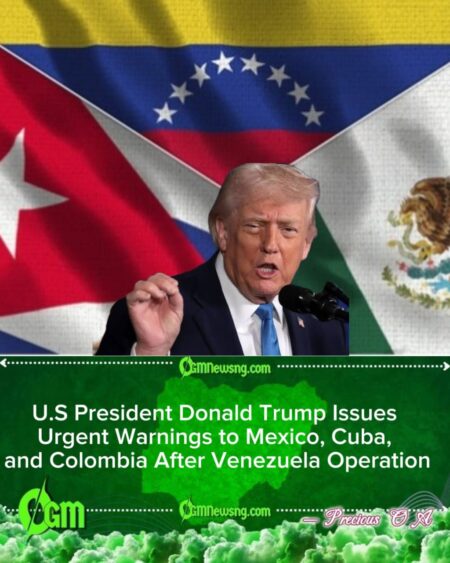
U.S President Donald Trump addressed the nation in the hours following reports of a major security operation connected to Venezuela, delivering a message that signaled a sharp escalation in diplomatic posture across the Western Hemisphere. The statement, issued through official channels, emphasized that the United States was entering what he described as a “new phase of regional vigilance,” warning that emerging threats would no longer be handled quietly or indirectly.
Administration officials explained that new intelligence assessments had prompted a review of diplomatic relationships, particularly with governments perceived as tolerating activities that Washington considers destabilizing. These assessments, while not publicly detailed, reportedly influenced urgent communications sent to multiple capitals in Latin America within hours of the operation becoming public.
U.S President Donald Trump later reiterated that the United States would continue to use “all appropriate diplomatic and strategic tools” to protect its national interests and regional stability. He stressed that this approach was not aimed at ordinary citizens in neighboring countries but rather at governmental decisions that Washington believes could enable transnational security risks.
Emergency Communications Across Latin America
Diplomatic sources confirmed that formal warnings were transmitted to Mexico, Cuba, and Colombia through established diplomatic channels. These communications urged regional leaders to increase cooperation, review internal security frameworks, and clarify their positions on recent developments tied to Venezuela.
Governments in the region responded cautiously, with officials in several capitals stating that they were reviewing the messages carefully. Analysts noted that the tone of the warnings suggested a sense of urgency that is not commonly seen in routine diplomatic exchanges, indicating that Washington views the moment as strategically sensitive.
U.S President Donald Trump reportedly approved the communications personally, underscoring their importance within the administration. White House aides characterized the move as part of a broader realignment of Western Hemisphere policy, one that places heightened emphasis on rapid response and preventive diplomacy.
Statements From U.S President Donald Trump on Regional Stability
U.S President Donald Trump described the Western Hemisphere as entering a “critical security crossroads,” warning that instability in one nation can quickly spill over into others. He argued that recent events connected to Venezuela demonstrated how fragile regional balance can be when security gaps are left unaddressed.
Senior officials echoed his concerns, emphasizing that regional partnerships would need to become more active and transparent. They suggested that future cooperation would likely involve increased intelligence sharing, joint monitoring initiatives, and coordinated policy planning among allied governments.
Political observers say the president’s language reflects a more assertive diplomatic posture that may shape upcoming regional summits and bilateral negotiations. The messaging signals that Washington intends to remain deeply involved in shaping political and security outcomes throughout the hemisphere.
Mexico, Cuba, and Colombia React
Government representatives in Mexico, Cuba, and Colombia issued measured responses, stating that they remain committed to dialogue and regional cooperation. They emphasized the importance of sovereignty while also acknowledging the need for collaborative solutions to shared challenges.
In Mexico City, officials highlighted ongoing partnerships with the United States in border management and security coordination. Cuban authorities, meanwhile, reiterated their call for mutual respect in diplomatic relations, emphasizing peaceful engagement over confrontation.
U.S President Donald Trump maintained that constructive cooperation remains possible, but stressed that it must be matched with clear accountability measures. He indicated that Washington would continue monitoring developments closely in the coming weeks.
International Analysts Weigh In
Security analysts described the situation as one of the most consequential diplomatic moments in the region in recent years. They noted that the warnings could lead to policy recalibrations in neighboring countries as governments seek to avoid becoming focal points of geopolitical tension.
Experts also suggested that the developments could influence trade talks, migration agreements, and multilateral security forums. These areas, they say, are often closely tied to diplomatic trust and shared security priorities.
U.S President Donald Trump has signaled that future negotiations may include new benchmarks tied to transparency and compliance, further embedding security considerations into economic and political partnerships.
What This Means for the Western Hemisphere
The broader implications of the warnings are still unfolding, but many observers believe they mark a turning point in hemispheric relations. Governments may face increasing pressure to align more closely with Washington’s security framework in order to maintain stable diplomatic ties.
Some regional leaders have already begun internal reviews of security protocols, anticipating that further diplomatic engagement could soon follow. These reviews may shape new laws, cooperative agreements, and monitoring initiatives.
U.S President Donald Trump has framed the moment as an opportunity for regional unity built on what he describes as “clear expectations and mutual responsibility.” His remarks suggest that the administration views the coming months as decisive for long-term stability.
Looking Ahead
Diplomatic sources indicate that follow-up meetings are likely to be scheduled, both bilaterally and through multilateral organizations. These discussions may focus on setting clearer standards for cooperation and outlining future response mechanisms.
Economic analysts are also watching closely, noting that heightened diplomatic tension can influence markets, trade routes, and investment flows. Stability in the region remains closely linked to political confidence and predictable policy frameworks.
U.S President Donald Trump concluded his latest remarks by stating that the United States “will remain fully engaged in protecting the hemisphere’s future,” signaling that Washington’s involvement in regional affairs is set to intensify rather than diminish.
Table of Contents
Discover more from OGM News NG
Subscribe to get the latest posts sent to your email.