









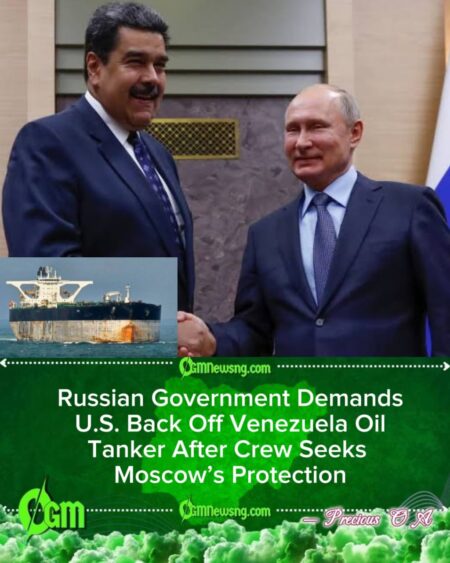
Russia officially asked the United States to stop pursuing the BELLA 1 oil tanker leaving Venezuelan waters, after the vessel’s crew painted a Russian flag across its hull and formally declared that it was operating under Russian legal protection. The unusual declaration, transmitted through diplomatic channels, immediately heightened tensions in Caribbean shipping lanes already strained by sanctions enforcement and energy geopolitics.
Russia stated that the tanker was carrying crude oil lawfully purchased under commercial contracts and that any interception, boarding, or redirection by U.S. authorities would be viewed as an unlawful interference with a vessel now claiming Russian jurisdictional affiliation. Maritime officials say such a maneuver — repainting a flag mid-voyage — is highly uncommon and carries significant legal ambiguity.
Shipping analysts noted that while vessels can change registry, the process is normally completed through port authorities and international registries, not while actively transiting contested waters. The sudden visual display of a Russian flag has nevertheless forced enforcement agencies to pause, review, and reassess next steps.
Sanctions, Seizures, and Shadow Shipping
Russia has argued that Washington’s sanctions regime has increasingly driven oil trading into what officials describe as a “shadow fleet” operating in legally gray zones. Over the past two years, dozens of tankers have been renamed, reflagged, and transferred among shell companies to move sanctioned oil across global markets.
Russia maintains that BELLA 1 had entered into new ownership arrangements prior to departure from Venezuelan ports, claiming that documentation proving the tanker’s legal association with Russian commercial interests had already been filed. Officials contend that these arrangements are valid under international maritime law.
Maritime insurers and compliance firms say that such rapid registry shifts are difficult to verify in real time, especially when ports, flags, and ownership chains span multiple jurisdictions, creating delays that complicate enforcement and legal clarity.
U.S. Enforcement Posture Under Review
Russia’s request directly challenges U.S. maritime enforcement authority in the Caribbean, where American naval and coast guard assets have been actively monitoring oil shipments connected to sanctioned states. U.S. officials have not publicly confirmed whether BELLA 1 was formally listed for seizure or redirection at the time of the Russian declaration.
Legal experts say Washington must now determine whether the tanker’s claimed Russian affiliation meets international recognition standards. If accepted, the ship could gain limited protections; if rejected, enforcement operations may proceed.
Diplomatic sources say the incident has triggered urgent interagency consultations involving the Treasury Department, State Department, Coast Guard, and Pentagon to avoid accidental escalation between nuclear-armed states.
Venezuela’s Role in the Dispute
Russia has pointed to Venezuela’s expanding oil exports as a key factor in the situation, describing Caracas as a strategic energy partner. Venezuelan ports have increasingly served as staging hubs for oil shipments linked to sanctioned or restricted markets.
Officials in Caracas have not formally commented on the BELLA 1 case, though state media has emphasized Venezuela’s right to conduct sovereign energy trade. Industry insiders say Venezuelan terminals have become critical for rerouting shipments as global energy alliances shift.
Energy analysts warn that further crackdowns could deepen supply volatility and complicate price stability across Latin American and Caribbean markets.
Maritime Law in a Grey Zone
Russia has framed the dispute as a test of international maritime law, particularly the rights of vessels that alter registry while underway. International conventions typically require registry changes to be validated by recognized flag states and port authorities before legal protections fully apply.
Legal scholars say BELLA 1 now occupies a contested legal status — potentially Russian in declaration, but not yet universally recognized in formal registries. That ambiguity leaves enforcement agencies cautious but uncertain.
The situation also highlights broader challenges facing international shipping as sanctions reshape global trade routes and create legal disputes rarely encountered in peacetime commerce.
What Comes Next
Russia has warned that any seizure attempt could have “serious diplomatic consequences,” though it has stopped short of specifying retaliatory measures. Behind the scenes, diplomats are reportedly exploring quiet resolutions that would allow the tanker to proceed without confrontation.
Shipping companies and insurers are closely watching the outcome, as the precedent set by BELLA 1 could influence how future tankers respond to sanctions enforcement.
For now, BELLA 1 remains a floating symbol of a growing geopolitical standoff — a single tanker at the center of a rapidly shifting global energy and maritime power struggle.
Table of Contents
Discover more from OGM News NG
Subscribe to get the latest posts sent to your email.