







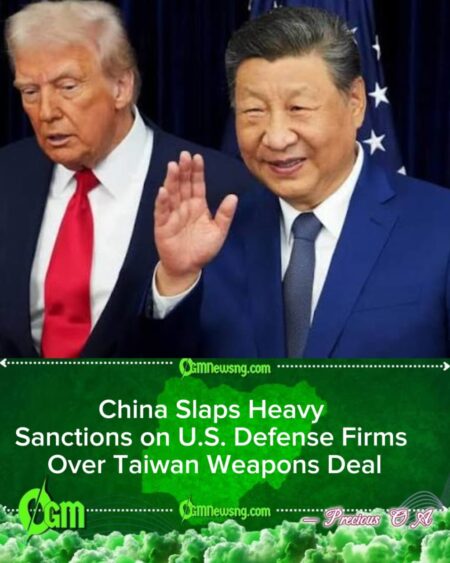
China has announced sweeping new sanctions against several major United States defense contractors following Washington’s latest weapons sales to Taiwan, a move that immediately intensified already fragile relations between the two global powers. The measures were unveiled after Beijing accused Washington of deliberately undermining Chinese sovereignty and emboldening what it describes as separatist forces on the island. Officials in Beijing framed the decision as both a legal response and a strategic warning, signaling that future arms transactions involving Taiwan would trigger even harsher retaliation.
China also emphasized that the sanctions are not symbolic gestures but targeted actions designed to inflict real economic and reputational costs on the companies involved. Chinese authorities stated that sanctioned firms would be barred from engaging in new business ventures in mainland China, excluded from government procurement programs, and restricted from forming partnerships with Chinese enterprises. These steps are expected to disrupt supply chains and long-term contracts that some of these companies have relied on for years.
Other Chinese policymakers further argued that the arms sales represent a dangerous escalation that threatens stability in the Taiwan Strait. They warned that Washington’s continued military cooperation with Taipei could provoke miscalculations, heighten military readiness on both sides, and increase the risk of accidental confrontation, potentially pulling regional allies into a broader conflict.
Scope of the Sanctions
China released a detailed list of defense contractors that would be directly affected by the sanctions, including companies known for producing missile systems, radar equipment, and naval defense technologies. Officials explained that the sanctions would restrict asset transfers, limit market access, and impose financial penalties on Chinese subsidiaries connected to the firms. This comprehensive approach aims to send a message not only to the listed companies but also to others considering future involvement in arms deals with Taiwan.
China also made it clear that executives of the sanctioned firms could face travel restrictions and tighter regulatory scrutiny if they attempt to operate in or engage with Chinese markets. Analysts say these personal-level measures represent a shift toward more individualized accountability, which could have a chilling effect on corporate decision-making across the defense sector.
Industry experts outside China note that while the immediate financial impact may vary, the long-term consequences could be significant. China remains one of the world’s largest markets for advanced manufacturing, and exclusion from that market could limit future growth opportunities for defense companies seeking international expansion.
Washington’s Reaction
China was quick to criticize early statements from Washington that characterized the sanctions as “unconstructive.” Beijing insisted that the United States had been repeatedly warned about the consequences of arms transfers to Taiwan and accused American officials of ignoring diplomatic channels in favor of strategic posturing.
American officials, meanwhile, defended the weapons sale as part of longstanding commitments to help Taiwan maintain a defensive posture. They argued that the sales are not meant to provoke Beijing but to preserve stability by ensuring Taiwan’s ability to deter aggression. However, U.S. lawmakers acknowledged that China’s response could complicate broader trade and diplomatic negotiations.
Political observers in Washington expressed concern that the sanctions could spill over into other sectors, including technology and energy cooperation. Some analysts warned that escalating tit-for-tat measures could harden positions on both sides, making compromise increasingly difficult.
Regional Implications
China highlighted that neighboring countries should not interpret the sanctions as a sign of weakness but rather as evidence of Beijing’s determination to defend what it considers core national interests. Chinese diplomats stressed that regional peace depends on respecting China’s territorial claims and avoiding actions that challenge its sovereignty.
China also urged regional partners to remain neutral and avoid being drawn into what it describes as a bilateral dispute between Beijing and Washington. Officials suggested that further militarization of the Taiwan Strait could disrupt trade routes, impact energy shipments, and destabilize financial markets across East Asia.
In response, several regional governments issued cautious statements calling for restraint and dialogue. While avoiding direct criticism of either side, they emphasized the importance of maintaining open communication channels to prevent misunderstandings and unintended escalation.
Economic Consequences
China defended the sanctions by asserting that economic tools are a legitimate means of enforcing national policy in the absence of military action. Beijing argued that its measures are proportional and targeted, focusing on companies that directly profit from what it sees as provocative arms transfers.
China further noted that domestic industries could benefit from the restrictions, as Chinese defense manufacturers may gain more opportunities to fill gaps left by sanctioned foreign firms. This could accelerate the development of indigenous defense technologies and strengthen China’s domestic military-industrial base.
Global markets reacted cautiously to the announcement, with investors monitoring potential ripple effects across technology, aviation, and shipping sectors. Financial analysts warned that prolonged tensions could dampen investor confidence and contribute to volatility in Asia-Pacific markets.
China concluded its announcement by reiterating that it remains open to dialogue but will not compromise on issues related to territorial integrity. Officials insisted that future actions by Washington regarding Taiwan would be closely watched and met with “resolute countermeasures” if deemed provocative.
Diplomatic experts suggest that both sides face difficult choices. While Beijing seeks to deter further arms sales, Washington must balance its commitments to Taiwan with the broader goal of maintaining stable relations with China, particularly in areas such as climate cooperation and global security.
As tensions continue to simmer, international observers are calling for renewed diplomatic engagement. Many believe that sustained dialogue, rather than escalating economic punishment, may be the only viable path toward preventing a deeper and more dangerous confrontation in the Taiwan Strait.
Table of Contents
Discover more from OGM News NG
Subscribe to get the latest posts sent to your email.