








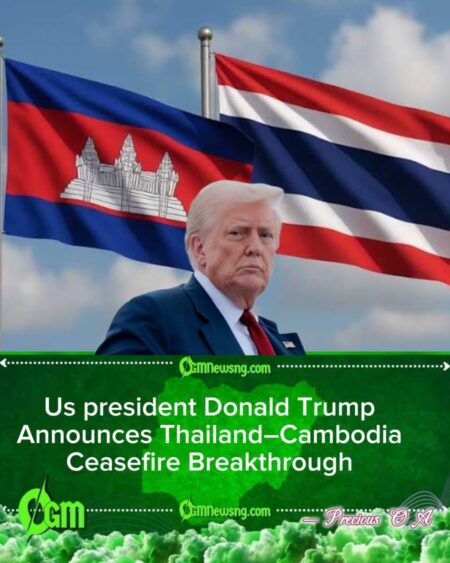
Us president Donald Trump said Thailand and Cambodia have agreed to immediately cease all fighting, announcing that both sides committed to halting hostilities and returning to the framework of his original peace agreement that had previously stalled amid renewed tensions. He characterized the development as a major diplomatic success, stressing that years of unresolved border disputes and sporadic clashes had pushed the region to a dangerous tipping point that required firm external mediation.
Donald Trump described the development as a decisive breakthrough, emphasizing that direct communication, sustained diplomatic engagement, and clear consequences for continued escalation helped bring leaders from both countries back to the table. He said the agreement was not improvised but built on earlier understandings that outlined ceasefire lines, de-escalation protocols, and political dialogue mechanisms that could now finally be enforced.
Regional observers noted that the announcement was met with cautious optimism, as communities near the conflict zone began reporting a noticeable reduction in artillery fire, troop movement, and military posturing shortly after the statement was made. Residents and local officials expressed hope that the pause in violence would allow displaced families to begin returning home and cross-border commerce to slowly resume.
Diplomatic Background
Donald Trump framed the ceasefire as the result of persistent diplomacy, stating that his administration had worked behind the scenes to remind both governments of the economic, humanitarian, and security costs of continued escalation. He argued that prolonged instability threatened regional trade routes and risked drawing in neighboring states, something both Bangkok and Phnom Penh were eager to avoid.
Donald Trump pointed to earlier negotiations that laid the groundwork for de-escalation, arguing that the original peace agreement already contained mechanisms for dispute resolution, border monitoring, and confidence-building measures that were simply not being enforced. According to him, the renewed commitment reflects a recognition by both sides that abandoning the agreement only prolonged uncertainty and hardship.
Analysts familiar with Southeast Asian diplomacy said the renewed commitment suggests both Thailand and Cambodia are seeking stability amid broader regional pressures, including economic recovery challenges and shifting geopolitical dynamics. They noted that renewed adherence to an existing framework is often more effective than attempting to draft entirely new agreements during moments of crisis.
Regional Reactions
Donald Trump said leaders in Thailand and Cambodia expressed relief at the opportunity to reset relations, noting that both sides acknowledged the toll the fighting had taken on civilians, infrastructure, and cross-border trade. He emphasized that restoring calm was essential not only for national security but also for maintaining public confidence in political leadership.
Officials from neighboring countries reacted by urging restraint and offering to support monitoring efforts, signaling a shared interest in preventing the conflict from spilling over into the wider region. Diplomatic sources indicated that several governments quietly encouraged both parties to accept mediation rather than risk further destabilization.
Donald Trump added that early diplomatic feedback indicated strong support for the ceasefire, with several ASEAN partners welcoming the return to dialogue and established agreements. He described the regional response as a sign that collective stability remains a priority despite underlying political differences among Southeast Asian nations.
Verification and Next Steps
Independent monitors cautioned that a ceasefire’s success depends on clear verification measures, including transparent communication between military commanders on both sides of the border. They warned that misunderstandings or isolated incidents could quickly unravel progress if not addressed promptly through established channels.
Donald Trump said the agreement includes provisions for observation and reporting, stressing that violations would be addressed swiftly through diplomatic channels rather than force. He emphasized that accountability and rapid response mechanisms were critical to preventing renewed clashes and restoring trust between the two militaries.
Donald Trump also highlighted plans for follow-up talks aimed at resolving lingering disputes, insisting that sustained engagement is necessary to turn a ceasefire into lasting peace. He said these talks would focus on long-term border management, economic cooperation, and confidence-building measures that reduce the likelihood of future confrontations.
U.S. Role and Leverage
U.S. officials underscored Washington’s role in facilitating dialogue, noting that economic ties, security cooperation, and diplomatic relationships provided leverage to encourage compromise. They described the ceasefire as an example of how targeted engagement can help de-escalate regional conflicts without direct military involvement.
Donald Trump argued that American involvement helped cut through months of deadlock, asserting that strong leadership and clear expectations were essential to achieving progress. He said the United States made it clear that continued instability would have consequences for broader cooperation, reinforcing the urgency of a negotiated solution.
Donald Trump maintained that continued U.S. engagement would focus on ensuring both sides adhere to their commitments while rebuilding trust damaged by the fighting. He emphasized that sustained diplomatic attention, rather than short-term intervention, would be key to maintaining momentum toward peace.
Outlook for Peace
Humanitarian organizations cautiously welcomed the ceasefire, calling for immediate access to affected areas to assess damage, deliver aid, and assist displaced families. They stressed that even a temporary halt in fighting could significantly reduce civilian suffering if properly maintained.
Donald Trump expressed confidence that the renewed adherence to his original peace agreement could stabilize the border if all parties act in good faith. He said the agreement provides a clear roadmap for de-escalation and cooperation, but warned that progress ultimately depends on disciplined implementation.
Regional experts concluded that while challenges remain, the agreement represents a meaningful step toward de-escalation, provided enforcement mechanisms remain credible and sustained. They noted that lasting peace will require patience, political will, and continued international support to ensure the ceasefire evolves into durable stability
Table of Contents
Discover more from OGM News NG
Subscribe to get the latest posts sent to your email.