







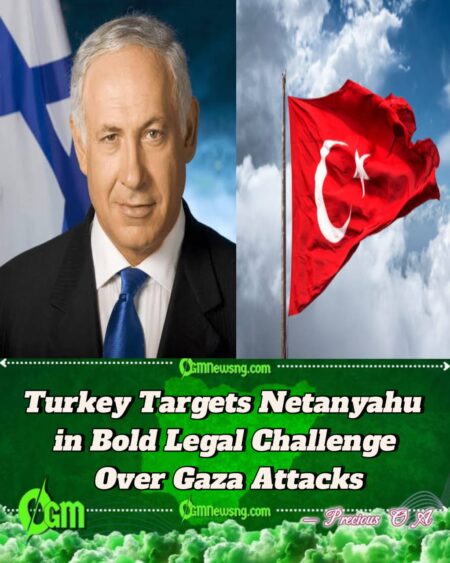
Turkey, a transcontinental nation bridging Europe and Asia, has long positioned itself as a powerful regional player with deep cultural, political, and religious influence across the Middle East. With its capital in Ankara and its largest city, Istanbul, serving as a hub of commerce and diplomacy, the country has often sought to balance its Western alliances through NATO with its commitment to supporting Muslim-majority nations. Under the leadership of President Recep Tayyip Erdoğan, Turkey has increasingly asserted itself as a vocal critic of Israel’s actions in Gaza and a defender of Palestinian rights on the global stage.
Turkey has now issued an arrest warrant for Israeli Prime Minister Benjamin Netanyahu, in what observers are calling one of the most dramatic diplomatic escalations in recent years. The warrant, announced by Turkish judicial authorities, accuses Netanyahu of war crimes and human rights violations stemming from Israel’s ongoing military operations in Gaza. Officials stated that the decision reflects Ankara’s determination to uphold international humanitarian law, regardless of political pressure. Analysts describe the move as unprecedented, noting that while Turkey has previously criticized Israel’s actions diplomatically, issuing a formal arrest warrant against a sitting head of government is a bold and historic step.
Netanyahu’s office swiftly condemned the move, labeling it as “a baseless and politically motivated provocation,” accusing Ankara of hypocrisy and interference. Israeli officials argued that Turkey’s justice system lacks the jurisdiction to pursue such charges, describing the arrest warrant as “symbolic political theater.” Experts suggest that while the warrant is unlikely to lead to Netanyahu’s arrest outside Turkey, it carries significant symbolic weight, demonstrating Ankara’s willingness to challenge Israel directly and bring international attention to civilian casualties in Gaza.
Turkey’s President Erdoğan defended the move, saying it was driven by moral responsibility rather than politics. “No one is above the law when it comes to crimes against humanity,” Erdoğan declared, adding that the warrant represents Turkey’s “commitment to global justice.” The statement immediately drew attention from world leaders and international media, signaling that the implications of this act could reshape diplomatic relations in the Middle East. The announcement also underscores Turkey’s growing confidence in using legal and political instruments to assert influence internationally, beyond traditional diplomatic channels.
Global Reactions and Diplomatic Fallout
Turkey’s decision has generated mixed responses across the international community. While some countries in the Middle East and North Africa have praised the move as “a courageous stand against injustice,” Western allies, including the United States and several EU members, have expressed deep concern. The United Nations has not yet issued an official position, though human rights organizations have commended Turkey’s effort to bring attention to the Gaza conflict’s civilian toll. Observers note that while Turkey’s warrant may not be enforceable globally, it raises awareness of international law and human rights obligations and could pressure other nations to take legal and humanitarian considerations more seriously.
The move highlights Turkey’s ongoing efforts to reshape its identity as a global moral authority and advocate for the Palestinian cause. Analysts suggest that Erdoğan’s strategy is aimed at rallying support from Muslim-majority nations while reinforcing Turkey’s influence in international diplomacy. In recent years, Ankara has intensified its criticism of Israel’s military actions, calling repeatedly for independent investigations into alleged war crimes. Political commentators argue that Turkey is using both legal tools and diplomatic messaging to strengthen its leadership role in the Muslim world, particularly as the Gaza conflict continues to attract global attention.
Turkey’s foreign ministry has defended the decision, emphasizing that it aligns with international law. Officials argued that ignoring civilian deaths in Gaza would amount to “global complicity.” However, the move has also strained relations with NATO partners, many of whom view the decision as a destabilizing act that could deepen divisions within the alliance. Diplomatic sources reveal that Ankara has been in behind-the-scenes talks with several European governments to explain the legal rationale, stressing that the arrest warrant is a legitimate judicial action rather than a political attack.
Turkey’s actions have also prompted discussions within the European Parliament, where several lawmakers have raised questions about how international institutions should handle politically sensitive war crime allegations. While the ICC continues to investigate the conflict independently, Ankara’s decision underscores the rising frustration among nations demanding faster accountability. Legal scholars note that Turkey’s approach may set a precedent for other countries to pursue similar legal actions, particularly in cases where international courts are perceived as slow or ineffective.
The Road Ahead: Legal and Political Implications
Turkey’s arrest warrant, though largely symbolic beyond its borders, carries significant political weight. Legal experts have pointed out that such a move could complicate Netanyahu’s international travel, especially to nations maintaining strong ties with Ankara or those that have extradition treaties with Turkey. Even if unenforceable, the warrant sends a clear message about Turkey’s intent to challenge Israel on both moral and legal grounds. Observers emphasize that the symbolic dimension may be just as important as any potential legal enforcement, as it positions Turkey as a nation willing to confront perceived injustices on a global stage.
Interpol has been notified of the arrest warrant, though it remains uncertain whether the international policing organization will act on it, given its longstanding policy of avoiding politically charged cases. Still, the symbolic gesture alone could amplify global pressure on Netanyahu, who already faces mounting domestic criticism for his handling of the Gaza conflict. Legal analysts note that while Turkey may not secure an actual arrest, the move reinforces a narrative of international accountability that could have diplomatic ripple effects for Israel worldwide.
Turkey’s move may also influence future diplomatic negotiations. If Ankara’s legal stance gains traction among sympathetic nations, it could open a new chapter in international accountability for war crimes. Erdoğan’s administration appears determined to maintain this stance despite global backlash, framing it as a defense of humanitarian values rather than a diplomatic attack. The Turkish government is reportedly prepared to pursue further legal avenues, including submitting documents and evidence to international organizations to strengthen the legitimacy of its claims.
The bold decision underscores Turkey’s growing determination to stand apart from Western hesitation on Gaza. Whether this results in tangible legal consequences or simply remains a historic gesture, the impact of this action is undeniable—it has deepened global debate on justice, sovereignty, and the limits of political power. Analysts agree that the warrant could inspire similar actions from other nations concerned with accountability, potentially reshaping how international law interacts with conflicts and military conduct.
Table of Contents
Discover more from OGM News NG
Subscribe to get the latest posts sent to your email.