







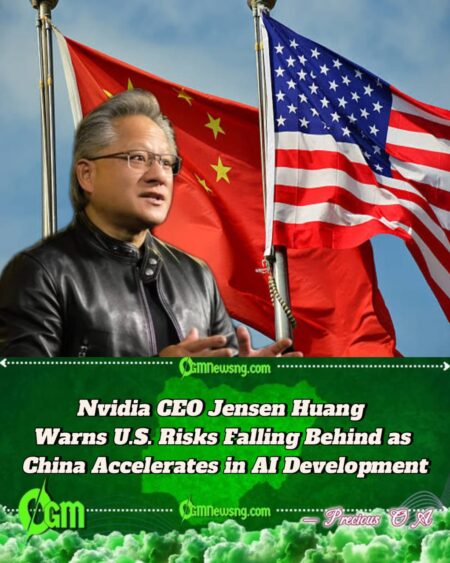
Nvidia CEO Jensen Huang, the Taiwanese-American tech visionary and co-founder of Nvidia, has sparked worldwide debate after declaring that China “will win” the artificial intelligence race against the United States. Jensen Huang, known for his pioneering role in revolutionizing computer graphics and AI chip technology, made the bold statement during a recent technology summit attended by global investors, AI researchers, and top policymakers.
He emphasized that China’s aggressive investments in computing infrastructure, AI research, and education have given it an unshakable momentum in the global race for artificial intelligence dominance. His remarks have ignited fierce discussions among policymakers, analysts, and tech experts across both nations, many of whom see his statement as both a warning and a prediction grounded in realism rather than provocation.
Jensen Huang underscored that China’s industrial scale, population size, and centralized focus on long-term technological development make it a formidable competitor. He elaborated that while the United States remains the innovation leader in AI research, algorithmic development, and software design, China’s rapid and organized approach to implementation gives it an advantage that should not be underestimated. According to Huang, the speed at which China deploys and integrates AI systems into manufacturing, transportation, and public services gives it a level of operational dominance that could outpace the fragmented progress seen in the West. He noted that “innovation alone is not enough if implementation lags behind,” emphasizing that efficiency and scalability will ultimately determine leadership in artificial intelligence.
Jensen Huang further warned that the U.S. risks falling behind if it continues to impose strict export restrictions on advanced chips, suggesting that such policies may inadvertently accelerate China’s domestic semiconductor industry. “When you block technology, you don’t stop innovation—you just redirect it,” he said, referencing Beijing’s growing push for AI self-reliance through large-scale national initiatives such as its “New Generation Artificial Intelligence Development Plan.” Huang added that technological isolationism could push China to achieve breakthroughs faster than expected, as necessity often drives the most rapid innovation.
His comments have reverberated across financial markets and political circles, with Nvidia’s shares momentarily fluctuating as investors weighed the potential implications of his statements. Many analysts viewed his remarks as a candid assessment of the global AI landscape rather than a political endorsement. His perspective adds new weight to the ongoing debate about balancing technological security with international collaboration. Industry leaders argue that Huang’s insights reflect the complex reality that technology cannot be entirely contained within borders in a world so deeply interconnected by data and digital infrastructure.
Strategic Tensions Between Two Superpowers
Jensen Huang’s remarks come amid a period of rising tension between the U.S. and China over advanced technology and AI chip exports. The Biden administration has recently tightened restrictions on the sale of high-performance semiconductors to China, aiming to limit its ability to develop military-grade AI systems and sophisticated computing platforms. Meanwhile, Beijing has continued to invest billions into AI-driven infrastructure, education, and innovation hubs, positioning itself as a self-sustaining technological superpower. These competing strategies have created an uneasy balance in global trade, innovation policy, and national security considerations.
Jensen Huang emphasized that the rivalry between the two nations should not descend into total isolation. He argued for a balanced approach that allows for healthy competition while maintaining open channels for research collaboration, global standard-setting, and ethical governance. Huang stated that AI should be seen as “a tool to elevate humanity,” not a weapon for political or economic dominance. According to him, progress in artificial intelligence must be driven by shared human values rather than rigid national rivalries.
Jensen Huang’s views have been interpreted by some as a pragmatic recognition of China’s unstoppable momentum rather than a dismissal of America’s innovative capacity. Economists have pointed out that China’s rapid adoption of AI across industrial sectors—ranging from robotics and logistics to healthcare and energy—has given it measurable advantages in efficiency, production, and data analysis. Huang’s comments have thus been read as a call to action for U.S. policymakers to rethink their strategy and invest in the domestic foundations of AI rather than relying solely on export controls.
Economic analysts note that if the United States fails to match China’s scale and speed in AI deployment, it may face long-term challenges in maintaining its technological leadership. They warn that industries such as finance, transportation, and national defense are increasingly dependent on AI-driven systems. As AI continues to transform every aspect of modern life, the outcome of this rivalry could define global economic power structures for decades to come.
Global Reactions and the Future of AI Leadership
Jensen Huang’s statement has drawn a wave of mixed reactions across the world. Some praised his candor and foresight, describing it as a much-needed wake-up call for U.S. leaders who may have underestimated the scale of China’s commitment to AI advancement. Others criticized his remarks as overly pessimistic, accusing him of downplaying America’s innovation capacity and its stronghold in cutting-edge AI research, ethical frameworks, and creativity-driven software ecosystems. Within the tech industry, many saw Huang’s statement as a challenge to complacency—a reminder that global leadership must be earned continuously through adaptation, not assumed by tradition.
Jensen Huang has long been regarded as one of the most influential and visionary figures in modern technology. His leadership at Nvidia has transformed the company from a graphics card manufacturer into a global powerhouse that fuels nearly every major AI system on the planet. From powering self-driving cars and data centers to enabling complex generative AI models, Nvidia’s chips form the backbone of today’s digital revolution. Industry observers say that Jensen Huang’s words carry particular gravity because Nvidia’s success is deeply intertwined with the trajectory of AI development across continents.
Jensen Huang’s prediction also reflects the broader geopolitical and economic shifts shaping the 21st century. As nations race to secure dominance in artificial intelligence, control over semiconductors, quantum computing, and big data infrastructure, the stakes extend far beyond technology. They influence global politics, security, and even cultural narratives about progress and human potential. Jensen Huang’s assessment serves as a mirror reflecting how deeply AI has become a measure of national strength and strategic independence.
Ultimately, the AI race may not yield a single “winner.” Experts suggest that while China may dominate in scale, infrastructure, and rapid deployment, the U.S. will likely continue to lead in creativity, foundational research, and innovation ethics. The most sustainable future, many argue, lies not in confrontation but in cooperation—where both superpowers share advancements for the benefit of humanity as a whole. In the end, the AI race is not just about machines or algorithms—it is about the collective human spirit striving toward progress, guided by wisdom, vision, and responsibility.
Table of Contents
Discover more from OGM News NG
Subscribe to get the latest posts sent to your email.