



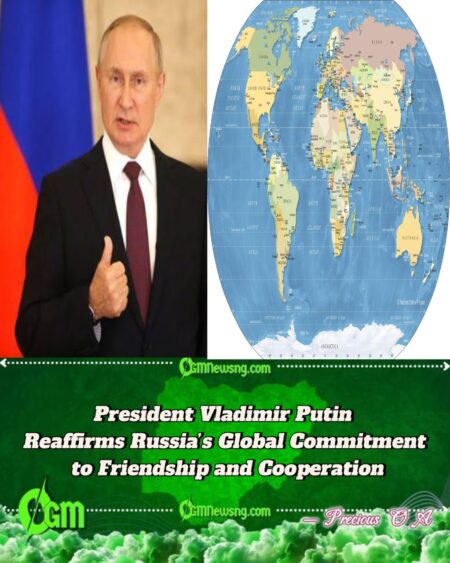
President Vladimir Putin, one of the most influential and closely watched world leaders whose words often carry tremendous weight across global corridors of power, reaffirmed Russia’s unwavering desire to maintain “friendship and cooperation with all nations of the world.” Speaking before an audience of diplomats, foreign dignitaries, and decorated cultural envoys at a Kremlin ceremony, he projected a tone of confidence, openness, and continuity in Russia’s foreign policy objectives.
Putin’s statement, brief yet deeply layered, was not merely a political declaration—it was a symbolic gesture intended to reaffirm Russia’s commitment to dialogue, peace, and mutual respect amid the ongoing complexities of world affairs. His words carried both emotional gravity and strategic significance, underlining the belief that Russia continues to see itself as a vital player in the maintenance of global harmony.
Putin reminded the audience that, despite the numerous geopolitical challenges and conflicts shaping the modern world, Russia remains steadfast in its mission to uphold fairness, cooperation, and respect for sovereignty. He emphasized that “the Russian world” has always embodied values of openness, hospitality, and cultural depth—qualities that have historically enabled it to build enduring partnerships across continents. His choice of words reflected a combination of national pride and diplomatic restraint, designed to convey that Russia does not seek isolation but rather inclusion on its own terms.
Putin went further to extend his gratitude to global leaders, peace advocates, and international cultural figures who have continued to maintain cordial relations with Russia despite turbulent political times. He praised such individuals for their courage, goodwill, and understanding, noting that cultural exchange, artistic dialogue, and intellectual cooperation serve as “unbreakable threads” that bind nations together. In his view, humanity thrives when nations value dialogue over division, and understanding over suspicion—a vision of global interaction that seeks to transcend political rivalry.
The event itself carried a profound symbolic message. Foreign ambassadors, artists, scholars, and human rights advocates gathered in the grand halls of the Kremlin not only to hear the president’s words but to witness Russia’s assertion of global openness. Observers described the atmosphere as dignified yet emotionally charged—a moment that sought to present Russia as a nation of peace, resilience, and partnership, rather than confrontation.
Framing Russia’s Diplomatic Posture
Putin’s remarks about universal friendship were not made in isolation but form part of a larger narrative in Russia’s foreign policy trajectory. Over the past decade, Moscow has gradually reshaped its diplomatic posture, focusing increasingly on fostering alliances outside traditional Western blocs. Putin underscored that Russia’s foreign relations are not limited to its immediate neighbors but encompass “all nations that seek peace, equality, and development.” This broader, more inclusive approach, he argued, reflects the reality of a multipolar world where cooperation must replace domination and where respect must triumph over interference.
Putin’s speech also aligned with Russia’s growing diplomatic engagement across Asia, Africa, and Latin America. He highlighted how recent trade agreements, infrastructure collaborations, and humanitarian projects have created fresh opportunities for shared growth. By diversifying partnerships and promoting new routes of international trade, Russia aims to demonstrate that global progress does not depend on unilateral policies but on collective understanding and mutual benefit. The president described these efforts as part of a moral and strategic framework that recognizes every country’s right to determine its own path toward prosperity.
Russian policymakers, echoing Putin’s tone, later emphasized that friendship and cooperation are now “strategic imperatives” rather than optional gestures. The Ministry of Foreign Affairs described the president’s message as a guiding principle of modern Russian diplomacy—a commitment to pursue dialogue even with nations that hold opposing views. This, they noted, reflects a fundamental belief in diplomacy as the ultimate instrument for resolving global crises.
Putin also turned his attention to the cultural and educational dimensions of international relations. He emphasized that art, science, and academic collaboration represent the “soft power” that brings nations closer together even when politics divide them. By referencing Russian literature, classical music, and space exploration, he reminded listeners of the nation’s long-standing contributions to global civilization. Culture, in his words, is not a weapon but a “universal bridge”—a timeless force that connects people through shared human experience and creativity.
Global Reactions and Broader Implications
Reactions to Putin’s statement were swift and varied. Some political observers praised his remarks as a timely reminder that cooperation remains the only viable path to stability in an increasingly polarized world. Diplomats from several African and Asian nations publicly commended the speech, describing it as “a refreshing reaffirmation of peace through partnership.” Others interpreted it as part of a broader diplomatic recalibration intended to strengthen Russia’s ties with the Global South amid continuing tensions with Western powers.
Critics, however, viewed the statement with skepticism, arguing that while the language of peace and cooperation was noble, it did not necessarily reflect the realities of current global politics. Western analysts noted that Moscow’s assertive foreign policy and military posture complicate its attempts to project an image of openness. Still, even among critics, there was acknowledgment that Putin’s rhetoric resonated deeply with many nations seeking alternatives to traditional Western-centered alliances.
Putin’s reference to equality among nations—regardless of size or influence—sparked considerable discussion among scholars of international relations. They observed that his statement echoed a consistent theme in Russia’s geopolitical philosophy: the advocacy of a multipolar world where power is distributed more fairly. In emphasizing the need for friendship “with all nations,” Putin sought to position Russia as both an independent power and a partner willing to engage constructively in shaping the global order.
Whether the speech leads to concrete diplomatic breakthroughs remains to be seen, but its tone and presentation were undeniably strategic. It was a speech that balanced idealism with realism—a public declaration that Russia wishes to be perceived as a global partner for peace, even amid divisions and challenges. The weight of Putin’s words, given his stature on the world stage, ensures that his message will continue to ripple through diplomatic circles, provoking reflection and dialogue far beyond Moscow’s walls.
Table of Contents
Discover more from OGM News NG
Subscribe to get the latest posts sent to your email.