








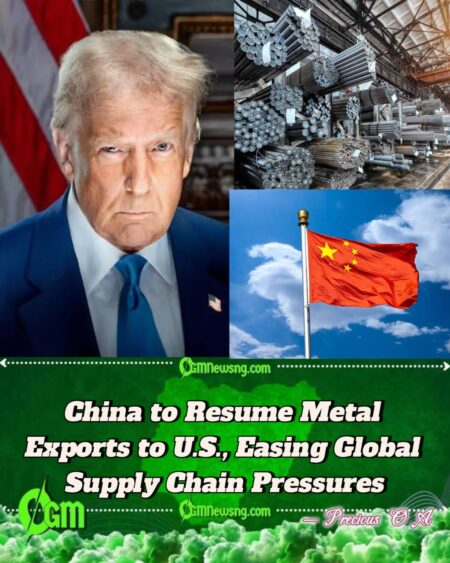
China, the world’s second-largest economy and a leading producer of metals and rare earth elements, has announced its decision to resume metal exports to the United States, a move signaling a notable easing in trade tensions between the two global powers. The decision, confirmed by China’s Ministry of Commerce early Monday, follows months of export restrictions that disrupted supply chains, led to significant price volatility in international markets, and raised global concerns over industrial production delays. Officials described the resumption as part of a “measured recalibration” of trade policy aimed at restoring balance and stability in international markets while maintaining China’s strategic control over its valuable resources.
China will initially focus on critical metals including rare earth elements, aluminum, and refined steel — materials essential for manufacturing, technology, and defense industries. The previous restrictions, imposed amid rising geopolitical tensions, had severely affected American manufacturers who rely heavily on Chinese raw materials for industrial production, forcing some companies to delay projects, seek alternative suppliers, or absorb higher costs. The ministry emphasized that the resumption is “not a concession,” but rather a “strategic adjustment” in line with China’s long-term economic goals, reflecting careful planning and consideration of global market dynamics.
Diplomatic exchanges between Beijing and Washington in recent months have helped pave the way for the resumption of metal exports. High-level meetings between trade officials and economic advisers in both capitals focused on the critical importance of maintaining stable industrial supply chains and avoiding further escalation that could harm both economies. Analysts predict that the renewed flow of metals could ease inflationary pressures in U.S. manufacturing sectors, which have faced rising production costs and delays due to limited access to key industrial inputs, particularly in the technology and renewable energy sectors.
China’s announcement was met with cautious optimism internationally. Officials in Beijing framed the decision as a gesture of goodwill, reaffirming China’s role as a reliable global supplier. Trade advisers in Washington expressed hope that the resumption could form a foundation for broader cooperation on economic and environmental issues, even as political divisions remain unresolved. The move was interpreted by some market watchers as a signal that China is willing to take pragmatic steps to ensure stability in global supply chains while simultaneously protecting its own economic interests.
Economic Implications for Global Markets
China’s return to exporting metals is expected to have an immediate and significant impact on global commodity markets. Analysts predict that the renewed supply could stabilize prices of critical materials, which have fluctuated dramatically in recent months due to scarcity, speculation, and the ripple effects of the trade freeze. Aluminum and rare earth prices surged over 20% during the export freeze, causing strain in industries ranging from electronics and automotive manufacturing to renewable energy and defense production. The resumption of exports is expected to provide relief to companies grappling with supply shortages and to reduce the risk of further inflation in the U.S. and global markets.
The country’s position as the world’s largest producer of refined metals gives it substantial influence over global supply chains. China controls nearly 70% of rare earth production and over half of global aluminum output. By reopening exports, China strengthens its economic leverage while signaling that it remains a key player in stabilizing global markets. This move is also viewed as a subtle reminder to international markets of China’s capacity to influence global industrial stability and its ability to strategically manage supply to maximize both economic and political outcomes.
China’s resumption of exports is also expected to prompt the United States to continue efforts to diversify its supply chains. While domestic mining initiatives and partnerships with allied countries are underway, experts agree that short-term dependence on Chinese metals will persist due to the scale and efficiency of China’s industrial production networks, which are unmatched globally. Companies in critical sectors such as electronics, automotive, aerospace, and renewable energy are particularly reliant on this supply and will benefit from the renewed access to materials that are essential for maintaining production schedules and meeting market demand.
State media in Beijing framed the export resumption as an act of responsibility toward the global economy, asserting that trade cooperation benefits all parties. Editorials emphasized that maintaining open trade channels strengthens stability and fosters international confidence, positioning China as a stabilizing force amid economic uncertainty. Chinese media also highlighted the strategic benefits of resuming exports, portraying the decision as a demonstration of China’s leadership and foresight in global trade matters, while simultaneously reinforcing its image as a reliable economic partner despite ongoing political tensions.
Political and Diplomatic Dimensions
China’s announcement comes at a politically sensitive time as U.S.–China relations continue to fluctuate between cooperation and confrontation. Trade, technology restrictions, and regional security issues have all strained relations, making the resumption of metal exports a potentially significant diplomatic gesture that could influence both economic and geopolitical calculations. By allowing the flow of metals to resume, China signals that economic pragmatism can coexist with political disagreements, providing a framework for dialogue and collaboration even amidst broader strategic rivalries.
Beijing aims to demonstrate that economic pragmatism can be separated from political disagreements, using trade as a tool for dialogue and influence. The move may also strengthen China’s negotiating position on tariffs, technology access, and investment policies while stabilizing domestic growth and reassuring global investors of China’s commitment to predictable market behavior. Analysts suggest that China is strategically balancing its need to project strength with the practical necessity of ensuring continued global demand for its industrial products.
China’s decision is expected to boost investor confidence and mitigate the slowdown caused by declining demand in Europe and Asia. Officials in Beijing argue that resuming exports is essential for sustaining export-driven growth while supporting global markets dependent on Chinese metals, which are critical to modern industrial economies. By taking this step, China also sends a message that it values the interconnectedness of global markets and recognizes the risks of prolonged disruption to international trade flows.
Analysts say the latest move could signal a fragile but meaningful step toward economic détente between the U.S. and China. While some view the resumption as a constructive gesture, skepticism remains due to previous trade disagreements that unraveled over compliance and enforcement issues, intellectual property disputes, and political mistrust. Markets are closely watching how the renewed exports will be implemented, monitored, and regulated to prevent future disruptions.
China’s metals are now once again flowing into the global market, and the ripple effects are expected to extend far beyond Washington and Beijing, reshaping industrial production, trade balances, and diplomatic relations for months to come. Companies, policymakers, and investors alike are closely evaluating the implications of this move, recognizing that it may mark the beginning of a new phase in global trade stability between the two largest economies in the world.
Table of Contents
Discover more from OGM News NG
Subscribe to get the latest posts sent to your email.