







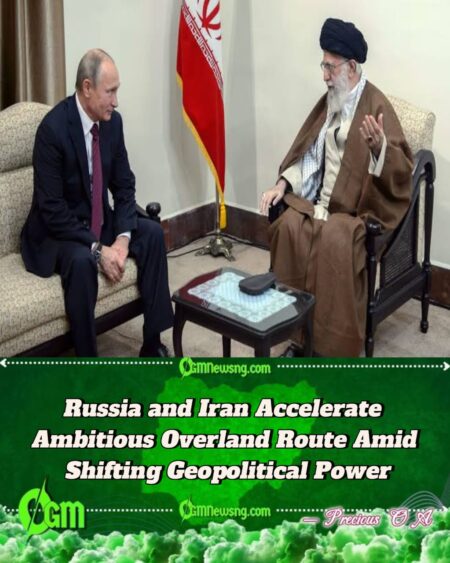
Russia and Iran, two sanctions-hit nations seeking stronger economic independence, are pushing forward on a massive and highly strategic infrastructure plan to establish a new overland-and-sea trade corridor linking the Persian Gulf to northern Europe. Positioned at opposite ends of a commercially important span stretching across the heart of Eurasia, both countries describe the route as essential for creating reliable economic lifelines and reducing reliance on maritime channels long dominated by Western allies. Their leaders have repeatedly emphasized that they share not only economic goals but also a political vision aimed at strengthening sovereign control over global commerce while asserting influence across the world stage.
The initiative aims to weave together upgraded railways, expanded port facilities, newly developed industrial zones, and advanced customs systems to ensure the seamless movement of goods from the warm waters of the Persian Gulf to major European markets. The corridor is being promoted as a revolutionary alternative to the Suez Canal—cutting traditional shipping distance by thousands of kilometers, reducing transit times for high-value cargo, and lowering operational costs for exporters eager to bypass congested existing routes. Officials in both nations believe this overland trade spine will eventually become one of the most dependable freight networks in the region.
Russia and Iran have framed this partnership as a long-term investment in mutual resilience. Moscow sees this as a powerful response to shifting global alliances, particularly as European restrictions have grown tighter and traditional maritime supply lines have become more politically fragile. Tehran, on its side, views the project as a direct pathway to boosting its regional influence, positioning Iran as an unavoidable gateway between South Asia and Europe and giving its manufacturing and agricultural sectors increased relevance in the global market.
Russia and Iran are also promoting the project as a bold symbol of the emerging multipolar world order. They highlight that reducing dependency on maritime chokepoints—like those near the Suez Canal or around the Strait of Gibraltar—can stabilize prices by shielding supply chains from sudden political disruptions. Their rhetoric underscores a strong determination to reshape how goods move internationally, shifting economic power closer to Eurasia’s interior.
Russia and Iran: Economic Advantages and Regional Opportunities
Russia and Iran insist the corridor will attract a wave of commercial interest from countries in Central Asia, the Caucasus, South Asia, and beyond. These nations currently rely heavily on long sea routes or unpredictable transit agreements to export goods. By opening a faster and potentially more secure pathway to Europe, the project promises a major boost for businesses trading agricultural products, refined petroleum, minerals, automobiles, construction materials, and advanced manufactured goods. Early feasibility discussions suggest that freight volumes could grow exponentially once the full network is complete.
Economic analysts note that the plan could significantly reshape regional trade patterns by encouraging the development of new economic clusters and global supply-chain hubs along the route. Entire inland cities may be transformed with the creation of modern logistics centers equipped with sophisticated tracking technology, refrigerated storage for perishable goods, and high-capacity intermodal terminals. These developments could support thousands of local jobs, foster innovation in rail and shipping engineering, and promote knowledge sharing between universities, technology firms, and industrial investors.
Russia and Iran hope that success will draw greater multinational participation, particularly from giant importers in India and China who consistently seek more flexible and affordable shipping networks. Diplomatic sources in both capitals have hinted that exploratory talks are already underway with several Asian states that view this corridor as a valuable complement—not a competitor—to China’s Belt and Road Initiative. The shared expectation is that the addition of new partner nations could speed up construction and expand the scope of the project far beyond initial projections.
Supporters argue that streamlined customs policies, cross-border financial agreements, and shared investment responsibilities will accelerate the corridor’s rollout. They describe the plan as a decisive challenge to older trade systems that predominantly favor a small group of powerful maritime nations. By establishing pricing fairness and expanding direct access to global markets, advocates believe the corridor may reshape trade power dynamics in ways that will benefit emerging economies for decades.
Infrastructure, Challenges, and International Reactions
Russia and Iran acknowledge that fulfilling this ambitious vision requires overcoming formidable logistical, engineering, and diplomatic obstacles. Railroad tracks must be expanded, reinforced, and in some regions completely rebuilt to meet modern cargo standards. Ports require deeper channels, new shipping cranes, and extensive storage capacity. Both countries also need to invest in advanced cybersecurity systems that protect cargo information, navigation data, and financial transactions from foreign interference.
Russia and Iran are preparing to rely partly on joint ventures and technology swaps with regional partners to secure financing and accelerate technical development. Construction plans include energy-efficient freight fleets, cutting-edge signaling systems for high-speed rail movement, and environmentally friendly shipping terminals designed to reduce emissions. Policymakers stress that the corridor must remain competitive even as the global economy transitions toward greener and more sustainable logistics practices.
Questions persist regarding how global powers will react—especially the United States and the European Union, who continue monitoring strengthened cooperation between Moscow and Tehran with concern. Critics warn that the infrastructure could enhance sanctioned industries and allow both nations to consolidate new forms of economic leverage over trade-dependent neighbors. Others fear it could complicate diplomatic efforts and further divide the balance of power in the Middle East and Eastern Europe.
Russia and Iran counter such criticism by insisting that the project is purely economic and intended to be inclusive rather than divisive. Officials argue that expanding trade should never be viewed as a threat to global peace or stability. Instead, they claim the corridor demonstrates a shared commitment to building new futures for developing regions that have long suffered from restricted market access and geopolitical limitations.
Table of Contents
Discover more from OGM News NG
Subscribe to get the latest posts sent to your email.