






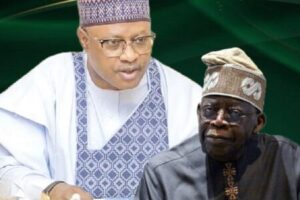



Uba Sani, Kaduna State Governor opened a celebratory account of his tenure by reminding listeners of the political landscape he inherited on May 29, 2023, when his party held just four of the state’s sixteen House of Representatives seats — a disparity he said would be corrected through deliberate engagement and persuasive governance. Speaking from the Green Chamber and on social media, the governor used the platform to stress that the jump from four to fourteen APC-aligned federal lawmakers in Kaduna was not accidental but the fruit of concerted outreach, political persuasion and policy-driven appeal to constituents across the state.
He portrayed the numerical shift as vindication for his administration’s priorities and political strategy, arguing that it reflected a renewed confidence among communities that had previously voted otherwise. Uba Sani framed the defections and alignments as a democratic realignment — citizens and their representatives choosing a platform they believed best matched their aspirations for development, security and representation.
While delivering the message with pride, the governor paired his boast with an appeal for unity, urging that the consolidation of party strength be translated into tangible programmes: improved infrastructure, heightened security responses and expanded socio-economic opportunities for Kaduna residents. He insisted that numerical dominance in the National Assembly must now be matched by measurable improvements on the ground.
Defections and parliamentary shifts: what changed in Kaduna’s political arithmetic
The recent inflow of lawmakers into the APC fold — including at least three members who publicly announced defections during a recent plenary — punctuated Uba Sani’s claim and altered the party balance from what it was at the start of his term. Observers noted these defections were formalised in the Green Chamber, with party registers and plenary announcements making the changes visible to the national legislature and to the electorate.
Political strategists tracking the situation say defections like these typically follow a combination of incentives: alignment with state executives, promises of constituency benefits, and the perception that affiliation with the ruling party facilitates access to federal projects. In Kaduna’s case, proponents of the switch told reporters that Governor Uba Sani’s people-centred rhetoric and outreach efforts persuaded several opposition lawmakers to realign politically.
Critics, however, framed the mass movement as potentially corrosive to pluralistic contestation, warning that when a single party accumulates most legislative seats through defections, the mechanisms of oversight, dissent, and rigorous debate can be weakened — an argument that has animated much of the commentary around Kaduna’s recent political metamorphosis.
Reactions, implications and the road ahead for Kaduna’s democracy
Governor Uba Sani’s triumphalist narrative has been met with a mix of acclamation by supporters and apprehension by opposition parties and civil society actors who stress that political consolidation must not eclipse accountability. Supporters say the APC’s ascendancy will fast-track development projects and harmonise governance between the state and federal levels; opponents counter that unchecked majorities can erode checks and balances.
Analysts urge that to preserve democratic health, the incoming APC majority in Kaduna’s House delegation must prioritise transparent legislation, commit to constituency service, and welcome institutional scrutiny rather than treating dissent as disloyalty. For many observers, the key test will be whether the numerical advantage translates into demonstrable policy outcomes that benefit ordinary citizens rather than merely consolidating partisan influence.
As the dust settles, Kaduna’s evolving political tableau will remain a live barometer of Nigeria’s broader dynamics around party loyalty, legislative behaviour and the interplay between state executives and their federal counterparts. Governor Uba Sani’s declaration — stark, unapologetic and politically consequential — has reframed the conversation: the question now is how the new balance will be used, and to whose advantage.
Table of Contents
Discover more from OGM News NG
Subscribe to get the latest posts sent to your email.