








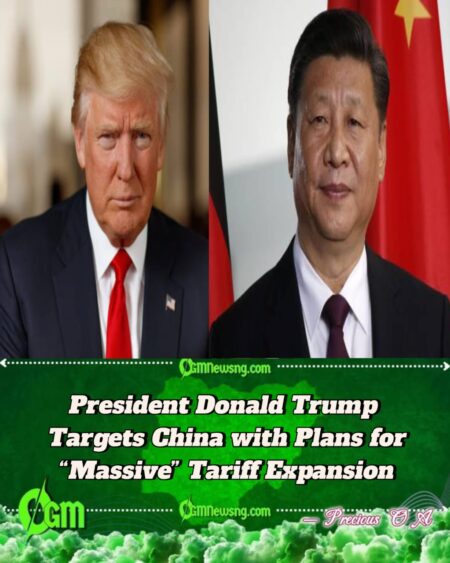
President Donald Trump, the 47th President of the United States and one of the most polarizing yet influential figures in modern American politics, has once again thrust global trade into the spotlight. Known for his “America First” economic philosophy and tough stance on foreign competitors, Trump announced that his administration is preparing a “massive increase of tariffs on Chinese products coming into the United States.” The declaration signals a possible new phase in U.S.-China economic confrontation, echoing earlier disputes from his first term but with greater intensity and global stakes.
Donald Trump, speaking from the White House’s Roosevelt Room, asserted that the United States had been “taken advantage of for decades” through what he described as unfair trade practices, intellectual property theft, and currency manipulation by Beijing. He claimed the time had come for Washington to act decisively to protect American industries and restore balance to global trade relationships.
Donald Trump’s aides later revealed that officials are currently evaluating a wide range of Chinese imports—from electronics and steel to consumer products—for potential tariff increases. While no specific timeline has been announced, sources indicate that the administration intends to roll out its first set of new duties before year’s end. “We are not afraid to defend American workers,” Trump said, “and we will ensure that our markets are never again flooded with cheap, state-subsidized goods.”
Economists and trade experts warn that the move could significantly disrupt international supply chains. Tariffs, they note, often lead to increased costs for American manufacturers who depend on Chinese materials and components. Analysts also caution that retaliatory tariffs from Beijing could hurt key sectors of the U.S. economy, particularly agriculture, where China remains a major buyer of soybeans, corn, and pork.
Despite widespread concern from corporate leaders and global markets, Donald Trump remains unwavering. He insisted that temporary discomfort is a necessary price for long-term national gain. “We have the strongest economy in the world,” he said confidently. “We’re in a position of power, and it’s time we used that power to ensure fairness in every trade deal the United States signs.”
Global Markets React to Tariff Threats
The president’s comments immediately reverberated through global markets. Stocks in Asia closed sharply lower, while U.S. futures wavered as investors digested the possibility of renewed trade conflict between the two economic superpowers. European exchanges also felt the tremors, with multinational corporations issuing cautious statements about potential disruptions to global supply chains.
Donald Trump’s announcement drew a swift and pointed reaction from Beijing. The Chinese Ministry of Commerce labeled the threat “unjustified and damaging,” warning that any escalation would “destabilize global trade order.” Economists in China suggested that countermeasures could include retaliatory tariffs on American exports, the suspension of bilateral negotiations, or the strengthening of economic ties with other trading blocs such as the European Union and ASEAN nations.
Investors flocked to safe-haven assets such as gold, silver, and U.S. Treasury bonds, while companies with heavy reliance on Chinese manufacturing—especially in the tech and retail sectors—saw their stocks decline. Wall Street analysts described the market response as a “flash warning” of how deeply intertwined the two economies remain.
Donald Trump’s economic advisers defended his hardline approach, stating that the administration’s ultimate goal is not to sever ties with China but to ensure reciprocity. “For years, American innovation has been exploited without adequate protection,” one senior official said. “This administration is setting a new standard: trade must be fair, transparent, and mutually beneficial.”
The political response in Washington reflected deep partisan divides. Several Republican lawmakers hailed Donald Trump’s toughness as long overdue, portraying it as a correction to decades of weak trade enforcement. However, Democratic leaders warned that escalating tariffs could raise prices for working families and undercut U.S. exports. Economists have echoed those fears, warning that uncertainty over tariffs could chill investment, slow growth, and drive inflation higher in the months ahead.
Domestic Implications for Industries and Consumers
Donald Trump has long positioned himself as a defender of the American worker, and the proposed tariff hikes fit neatly into his broader economic narrative. He argues that protecting U.S. industries from unfair foreign competition will ultimately strengthen domestic employment and encourage companies to invest at home.
Manufacturing leaders responded with cautious optimism. While many applauded the president’s commitment to reviving American industry, some warned that abrupt policy changes could backfire by raising production costs. “Tariffs may level the playing field,” one manufacturing executive noted, “but they also make raw materials more expensive, which can hurt smaller businesses.”
Donald Trump acknowledged those concerns but said his administration is preparing offsetting measures, including new tax incentives, infrastructure investments, and low-interest manufacturing loans. He explained that these initiatives would help American producers weather short-term turbulence while positioning the nation for long-term success.
Consumer advocates, however, remain skeptical. They warn that tariffs function as hidden taxes on households, increasing the prices of everyday goods like clothing, electronics, and furniture. If enacted on a large scale, such tariffs could reduce purchasing power and slow consumer spending, which fuels nearly 70 percent of the U.S. economy. Economists also point to the possibility of retaliatory tariffs affecting American farmers, who have historically borne the brunt of trade disputes with China.
Donald Trump closed his address with a firm declaration of intent. “The United States will not back down,” he said. “We will pursue policies that protect our workers, safeguard our industries, and restore respect for our economic sovereignty.” As both nations prepare for another round of negotiations, the world watches closely to see whether diplomacy can prevail—or if the U.S. and China are heading toward another round of trade confrontation with consequences that could ripple across the global economy.
Table of Contents
Discover more from OGM News NG
Subscribe to get the latest posts sent to your email.