









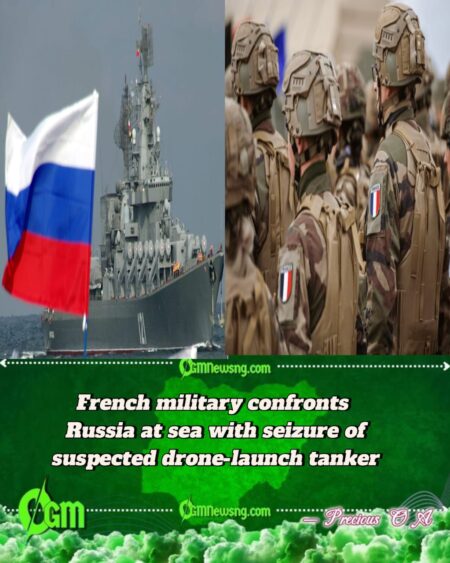
French military forces boarded and seized a Russian-linked oil tanker off the western coast of France in one of the most decisive maritime actions Europe has taken this year. The vessel—listed under the names Boracay and Pushpa—was intercepted after intelligence linked it to suspected drone operations in Danish airspace. Escorted by warships, it was diverted toward Saint-Nazaire, where prosecutors in Brest have begun a formal investigation.
French military personnel detained two crew members during the operation, citing multiple maritime offences including refusal to verify the ship’s nationality and failure to comply with inspection orders. Prosecutors describe the case as “a grave and unprecedented breach” of European security norms. Investigators are also examining whether the tanker was used as a mobile base for unmanned aerial systems.
The French Ministry of Armed Forces has said the action reflects a new phase in France’s response to hybrid threats at sea. Naval experts view the seizure as a shift from passive monitoring to active interdiction, sending a deterrent message to vessels engaged in covert or sanctions-busting operations. Officials argue that only decisive enforcement can disrupt the shadow-fleet network operating on Europe’s doorstep.
French military intervention has drawn praise from President Emmanuel Macron, who has urged European partners to tighten maritime enforcement and close loopholes exploited by Russia’s so-called “shadow fleet.” Macron’s remarks at a defence summit underlined the strategic stakes of the operation, which he linked to protecting both European security and the integrity of sanctions regimes. The Kremlin, meanwhile, has called the seizure “provocative” and denied knowledge of the vessel’s activities.
Drones, Disruptions, and Shadow Fleet Strategy
French military sources say the seized tanker is suspected of launching drones over Danish airspace, an allegation that has unsettled European aviation authorities. Airports in Copenhagen and Aalborg were temporarily closed on 22 and 24 September after unidentified unmanned aircraft were sighted, prompting immediate security alerts. Tracking data from independent maritime monitors placed the Boracay among several vessels operating nearby.
This episode highlights the dual role of Russia’s so-called “shadow fleet” of oil tankers and commercial ships. Operating under flags of convenience, turning off identification systems, and hiding behind shell companies, these vessels evade sanctions while potentially carrying out hybrid operations such as surveillance, sabotage or drone launches. Maritime analysts have long warned that the same ships transporting restricted commodities could be repurposed for covert military tasks.
French military officials point out that Europe’s response to this challenge has been evolving. In recent months, the EU has expanded sanctions to target shipowners, insurers and technical service providers linked to shadow-fleet operations. Baltic and Nordic states are discussing a “drone wall” along critical sea lanes to detect and neutralize unmanned aircraft launched from international waters. France’s boarding of the tanker marks the first time such a measure has been applied to a large vessel suspected of dual-use activity.
French military action thus represents a watershed moment in Europe’s counter-hybrid strategy. By detaining a ship alleged to combine oil transport with drone deployment, France is signalling that sanctions evasion and covert operations at sea will be treated as inseparable threats. Security specialists add that these tankers are often aged and poorly maintained, posing environmental dangers alongside security risks.
Regional and Global Implications
French military operations have now set off a wave of diplomatic discussions within the European Union. Denmark, which experienced the drone incursions, has called the seizure “an important precedent” and urged member states to share intelligence and harmonise legal frameworks for prosecuting hybrid maritime operations. Several Baltic and Nordic countries are pressing for a joint task force to monitor and interdict suspect vessels operating under opaque ownership.
Russia has sharply criticised the seizure, calling it “unlawful” and warning of possible retaliation. Kremlin spokespersons argue that intercepting commercial ships without conclusive evidence undermines international shipping norms. European officials counter that the tanker was boarded under lawful procedures and that hybrid threats justify prompt action before evidence dissipates or vessels slip into non-cooperative jurisdictions.
French military enforcement is also being watched closely across the Atlantic. The United States has already backed proposals for increased intelligence sharing with European partners, though no direct U.S. involvement in this seizure has been reported. President Trump’s administration is debating whether to expand naval support for allied interdiction efforts in the North Atlantic and the Baltic. The outcome of France’s investigation could shape future transatlantic coordination on maritime security.
Environmental groups are emphasising the ecological risks of the shadow fleet. Many of these tankers operate with minimal oversight, lack reliable insurance and carry heavy crude under conditions that could lead to catastrophic spills. By removing a potentially hazardous vessel from circulation, France is not only taking a security measure but also preventing possible environmental damage to European waters.
French military planners now face the challenge of turning a single operation into a sustainable policy. Whether the tanker is ultimately proven to have launched drones or not, the seizure has already become a test case for Europe’s ability to police the grey zone where commercial shipping meets covert military activity. The precedent it sets will resonate from the Baltic to the Atlantic and shape how the West responds to hybrid threats at sea.
Table of Contents
Discover more from OGM News NG
Subscribe to get the latest posts sent to your email.