





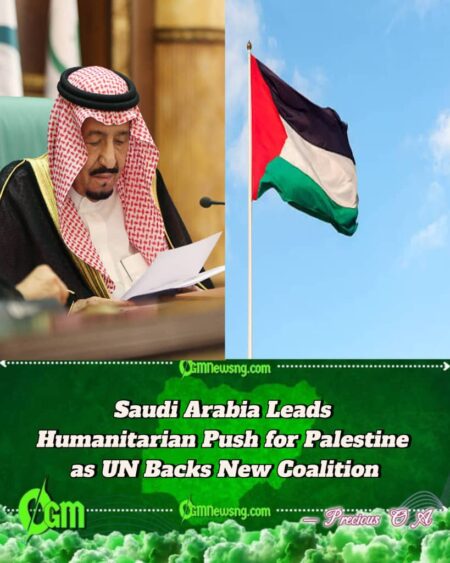
Saudi Arabia has announced a $90 million emergency aid package to the Palestinian Authority (PA), marking one of its largest single pledges in recent years. The announcement came on the sidelines of the 80th United Nations General Assembly, where Foreign Minister Prince Faisal bin Farhan presented the plan as part of a broader coalition effort. The pledge is aimed at averting institutional collapse in Palestinian territories and restoring momentum toward a two-state solution.
Saudi Arabia stressed that the new package is not merely financial assistance but part of a larger strategic plan to stabilize governance structures in Gaza and the West Bank. The Kingdom said its funding will complement international humanitarian programs already on the ground, ensuring that essential services such as healthcare, schooling, and civil administration continue without interruption.
Saudi Arabia also indicated that this initiative is anchored within the “Global Alliance for Implementation of the Two-State Solution,” a multilateral framework co-chaired by the Kingdom, the European Union, and Norway. By placing its pledge within this framework, Riyadh underscores the message that Arab leadership remains indispensable to resolving the Palestinian question.
Saudi Arabia signaled that the coalition includes “important partners” from Europe, North Africa, and Asia. Egyptian and Jordanian foreign ministers quickly voiced support, emphasizing that the PA must remain the core actor in Gaza reconstruction and state-building efforts. Both ministers also reiterated that Israeli settlement expansion is undermining hopes for peace.
Humanitarian Lifeline and Political Significance
Saudi Arabia is stepping in at a time when the PA faces a severe fiscal crisis. Salaries for public employees are months in arrears, hospitals are short on supplies, and schools struggle to operate under resource constraints. The Kingdom’s pledge is expected to plug immediate budget gaps and restore a measure of institutional stability, at least temporarily.
The aid package also dovetails with support for the United Nations Relief and Works Agency for Palestine Refugees (UNRWA). In previous years, the Kingdom boosted UNRWA funding to cover deficits in Gaza and refugee camps across the region. By routing a large share of the new funds directly through the PA, Saudi officials hope to reinforce its legitimacy as the primary channel for public services and governance.
Riyadh’s coalition push carries diplomatic weight. Analysts say the move pressures Israel and its allies—including the U.S. under President Donald Trump—to re-engage on political modalities rather than only security arrangements. Saudi officials have reportedly warned Washington that annexation plans in the West Bank would “kill” any path to normalization.
Critics, however, caution that without a durable ceasefire and political unity among Palestinian factions, even substantial funding may yield only short-term relief. They note that unless Israeli authorities release withheld tax revenues and ease access restrictions, the PA’s ability to implement programs will remain constrained.
Risks, Oversight, and the Path Forward
Saudi Arabia acknowledges that aid alone cannot unlock a durable peace. Officials say the coalition will adopt robust transparency and monitoring mechanisms to ensure funds are used for public welfare and not lost to inefficiency or factional disputes. The Kingdom’s leadership of the coalition places it in the spotlight and subjects it to regional and international scrutiny.
The initiative also confronts operational risks. Gaza remains under tight access controls, and sporadic violence threatens the safety of aid workers. Without sustained diplomatic pressure, humanitarian corridors may remain unreliable, impeding the very programs the coalition seeks to support.
Despite these obstacles, the coalition is seen as a rare opportunity to revive global focus on the two-state framework. If successfully managed, it could preserve Palestinian institutional integrity, build confidence among donors, and reframe Arab involvement as constructive and forward-looking.
Saudi Arabia has framed the initiative as part of a long-term strategy, not a one-off gesture. The Kingdom argues that only by linking humanitarian relief with political progress can the cycle of crises in Palestinian territories be broken. The coming months will reveal whether the coalition can deliver on its ambitious goals and push the conflict back toward a negotiated settlement.
Table of Contents
Discover more from OGM News NG
Subscribe to get the latest posts sent to your email.