






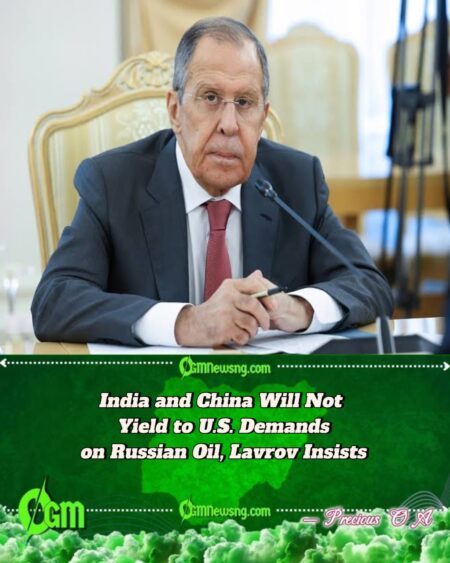
Lavrov, Russia’s long-serving Foreign Minister and the country’s top diplomat since 2004, has openly criticized U.S. attempts to pressure India and China into cutting oil purchases from Russia, dismissing Washington’s threats of tariffs as ineffective. The veteran diplomat argued that no amount of economic coercion would succeed in forcing sovereign states to abandon what he described as pragmatic energy partnerships.
Lavrov said the U.S. campaign is designed to weaken Russia’s ability to fund its ongoing military operations in Ukraine, but insisted that Asian nations will not bend to American pressure. He emphasized that New Delhi and Beijing, as two of the world’s largest importers of energy, make decisions guided by their national interests, not outside demands.
Lavrov underscored that Washington’s threats highlight a wider pattern of interference, in which powerful states seek to dictate economic choices to others. He portrayed Russia as a dependable supplier determined to meet the energy needs of partners willing to engage on fair terms, without conditions imposed from abroad.
Analysts note that Lavrov’s comments reflect Moscow’s confidence in its pivot to Asia. With European markets largely closed due to sanctions, Russia has redirected much of its crude oil toward India and China, offering discounts that ensure continued demand.
Strategic Role of India and China
Lavrov pointed to India and China as central players in global energy flows, stressing their determination to secure affordable oil regardless of geopolitical pressure. Their reliance on imports makes them highly sensitive to price fluctuations, and Russian discounts have proven too significant to ignore.
Lavrov noted that Moscow has worked to expand trade frameworks with both countries, including settling payments in national currencies and developing shipping routes independent of Western insurers. These measures, he said, safeguard energy cooperation from the reach of U.S. sanctions.
From Washington’s perspective, however, the issue is one of credibility. The United States, under President Donald Trump in his second term, has invested heavily in sanctions to reduce Moscow’s revenues. Allowing India and China to continue purchasing oil in large quantities undermines that strategy and calls into question the overall effectiveness of economic pressure.
Officials in New Delhi and Beijing have defended their stance by citing national priorities. Indian leaders argue that with a growing population and economy, securing stable and affordable energy supplies is nonnegotiable. China, meanwhile, frames its cooperation with Russia as part of a broader strategic partnership that extends beyond oil.
Energy experts suggest this dynamic reveals the limits of unilateral pressure. Without broad alignment from major importers, sanctions risk producing uneven results, hitting some markets hard while leaving others open to Moscow.
Lavrov Highlights Global Stakes
Lavrov warned that U.S. threats risk destabilizing global energy markets. He suggested that applying tariffs on two of the world’s largest economies could provoke retaliatory measures, drive up energy costs, and create volatility that harms not only Russia but also Western consumers.
Lavrov framed the issue as part of a broader shift in international order. He argued that Washington’s reliance on sanctions and tariffs is evidence of waning influence, while Russia’s outreach to Asia demonstrates a capacity to adapt to changing global realities. According to him, efforts to isolate Moscow will only accelerate the emergence of a multipolar world.
Lavrov’s defiance underscores a fundamental question about the future of sanctions as a policy tool. While they remain central to U.S. strategy, their success depends on widespread cooperation. The reluctance of major non-Western economies to fall in line shows the challenge of imposing uniform restrictions in a fragmented international system.
Lavrov’s comments also reveal Moscow’s determination to resist Western pressure by cultivating stronger ties with countries that prioritize economic opportunity over political alignment. This approach, while controversial in the West, has provided Russia with steady markets that help soften the blow of sanctions.
The broader implications extend beyond the immediate conflict in Ukraine. By testing the limits of sanctions and countermeasures, this dispute could reshape global trade patterns, redefine alliances, and influence how states navigate economic pressure in the future.
Table of Contents
Discover more from OGM News NG
Subscribe to get the latest posts sent to your email.