









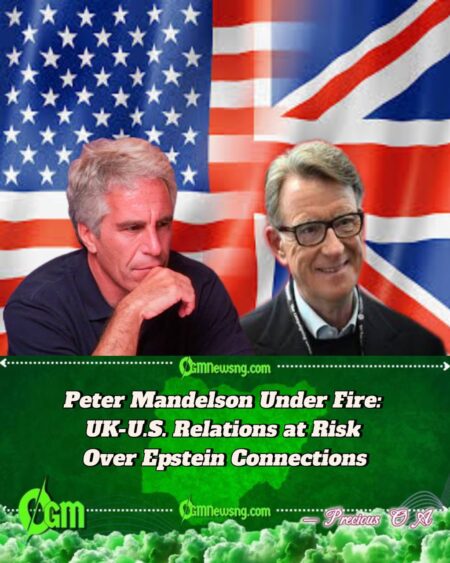
The UK Ambassador to the U.S., Peter Mandelson, has been dismissed by the British government following the emergence of emails linking him to disgraced financier Jeffrey Epstein. The decision was confirmed late Wednesday after officials reviewed private correspondence that raised concerns over his judgment and professional integrity.
Among the documents under scrutiny was an email dated June 2008 in which he wrote to Epstein, “I think the world of you.” The timing of the message is particularly significant, as it coincided with Epstein’s legal troubles surrounding charges of sex crimes involving minors. Senior Whitehall officials, after reviewing the communications, concluded that the UK ambassador’s personal relationship with Epstein was incompatible with his diplomatic post in Washington.
British Foreign Secretary Eleanor Reeves released a statement noting that “the standards expected of our diplomats must be beyond reproach. The UK ambassador’s communications, while private, crossed a threshold that undermines public trust.” The government has not named an immediate replacement but indicated that a caretaker ambassador will assume duties until a permanent appointment is made.
The revelation has provoked widespread debate in London, with some lawmakers demanding deeper inquiries into the extent of the UK ambassador’s relationship with Epstein. Questions remain about whether other high-profile figures may have maintained inappropriate connections with Epstein during and after his legal controversies.
Political Fallout in London
Peter Mandelson’s dismissal has sparked political turbulence within the United Kingdom, with opposition parties accusing Prime Minister Victoria Hale’s government of failing to act quickly enough once initial concerns about the ambassador surfaced.
Peter Mandelson’s email exchanges have reignited debates over the ethical responsibilities of senior officials. Labour Party leader Daniel Price stated in the House of Commons, “This firing, though necessary, comes far too late. It is evidence of a government that tolerates questionable behavior among its senior representatives until public exposure leaves them no choice.” The statement drew applause from opposition benches and criticism from members of the ruling Conservative Party.
The public is divided, with some commentators suggesting that the government’s swift action demonstrates accountability, while others argue that the credibility of British diplomacy has already suffered. Political analysts warn that the controversy may erode public trust at a time when Britain seeks to strengthen its international reputation.
Peter Mandelson’s case has prompted calls for a thorough review of diplomatic appointments and the vetting process for high-ranking officials, emphasizing the importance of transparency. Observers note that ethical lapses at senior levels can have long-term consequences for Britain’s global image.
Peter Mandelson’s personal and professional judgment will likely be scrutinized in future inquiries, with many observers noting that the emails exposed a troubling lapse in discretion at the highest levels of British diplomacy.
Peter Mandelson: International Implications
Peter Mandelson’s dismissal carries weight in the international arena, particularly in Washington, where he had been serving as one of Britain’s most senior diplomats. The U.S. State Department has not formally commented on his removal, but sources indicate that American officials were aware of the investigation before the firing was announced.
The UK ambassador’s ties to Epstein may complicate Britain’s diplomatic interactions, as trust between allied governments is often sensitive to controversies surrounding key envoys. While the relationship between the U.S. and the U.K. remains strong, analysts suggest that such incidents highlight the importance of ethical standards in international representation.
Diplomatic experts caution that the U.K.’s credibility with its American counterparts could face strain, particularly as questions arise about how much London knew regarding the ambassador’s relationship with Epstein before his appointment.
In the wider global context, the dismissal of the UK ambassador is likely to intensify oversight of world leaders and senior officials with prior associations with Epstein. Governments may face increasing pressure to review past connections and ensure that controversies do not compromise official representation or international relations.
The British government’s decision to remove the UK ambassador signals a commitment to maintaining diplomatic integrity, but the long-term consequences for Britain’s foreign policy credibility remain uncertain. Observers note that while swift action may mitigate some reputational damage, the scandal will linger in public discourse and international commentary for months to come.
Table of Contents
Discover more from OGM News NG
Subscribe to get the latest posts sent to your email.