







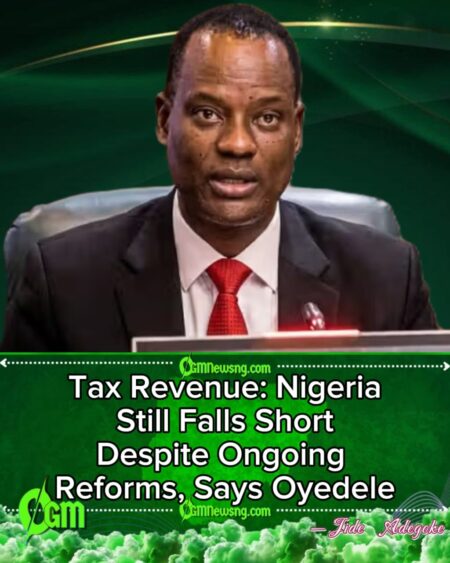
Tax Revenue remains one of Nigeria’s greatest economic challenges, according to Taiwo Oyedele, who says the country is still generating far less revenue from taxation than it needs to fund development. Speaking in Abuja during activities marking the Chartered Institute of Taxation of Nigeria’s maiden National Tax Awareness Day Road Walk, Oyedele argued that expanding tax compliance—not merely increasing taxes—has become essential if Nigeria hopes to reduce dependence on borrowing and volatile oil earnings. His remarks have reignited debate over whether ongoing fiscal reforms can finally transform the country’s fragile revenue system.
Revenue Challenge And Model Of Awareness To The Public
Taiwo Oyedele made the remarks while receiving the leadership of the Chartered Institute of Taxation of Nigeria, led by its President, Innocent Ohagwa. He praised the institute’s efforts to promote public awareness, describing tax education as a critical component of improving voluntary compliance across the country. According to him, many Nigerians remain outside the formal tax net, while government revenue continues to fall below levels required to adequately finance public services.
The Tax Revenue challenge has become increasingly significant as Nigeria faces rising expenditure on infrastructure, healthcare, education, security, and debt servicing. Fiscal authorities have repeatedly argued that strengthening tax administration, reducing leakages, simplifying compliance procedures, and broadening the tax base offer more sustainable solutions than introducing higher tax rates. Recent reform proposals have therefore focused on efficiency, fairness, and encouraging businesses operating informally to enter the formal economy.
Reforms Based On Sustainable Revenue
Nigeria’s tax-to-GDP ratio has remained among the lowest globally for several years, despite repeated efforts by successive administrations to strengthen domestic revenue mobilisation. Experts have long argued that the country’s challenge is not necessarily high tax rates but weak collection efficiency, widespread informality, multiple taxation by different levels of government, and persistent public distrust over how tax revenues are spent. These structural weaknesses have limited the government’s fiscal capacity even as public expenditure continues to rise.
The Tax Revenue debate has also intensified following the work of the Presidential Committee on Fiscal Policy and Tax Reforms, chaired by Taiwo Oyedele, which has proposed wide-ranging reforms designed to simplify Nigeria’s tax system, harmonise multiple taxes, encourage investment, improve compliance, and protect low-income earners. Supporters believe these reforms could significantly improve revenue generation while making taxation more transparent and business-friendly. Critics, however, maintain that government must first demonstrate stronger accountability and visible delivery of public services if voluntary tax compliance is to improve sustainably.
Ultimately, the success of Nigeria’s Tax Revenue reforms may depend not only on new legislation but also on rebuilding public trust between taxpayers and government institutions. As implementation of fiscal reforms continues, citizens, businesses, and policymakers will closely monitor whether improved tax administration translates into better public services, reduced borrowing, and stronger economic stability. OGM News Nigeria will continue following developments as the reforms progress
Table of Contents
Discover more from OGM News NG
Subscribe to get the latest posts sent to your email.