







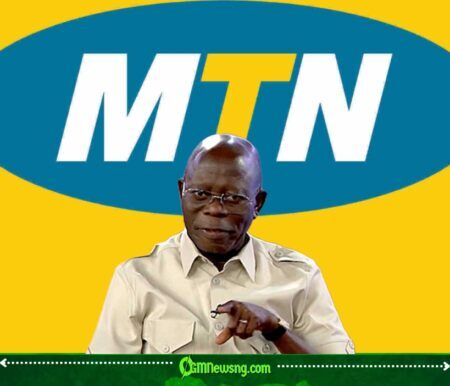
Senator Adams Oshiomhole doubled down on controversial remarks suggesting the Nigerian government should take over shares of MTN held by South African citizens and place them under Nigerian management. The comments immediately triggered intense reactions from political figures, investors, business leaders, and ordinary Nigerians concerned about the implications for foreign investment and corporate stability.
Senator Adams Oshiomhole defended his position by arguing that Nigerian law recognizes both “hostile” and “friendly” corporate takeovers, insisting that the foreign-owned portion of MTN could legally be transferred into Nigerian control. He specifically argued that because MTN operates heavily within Nigeria’s economy and telecommunications sector, the country has a legitimate interest in controlling strategic aspects of the company’s operations and ownership structure.
The remarks quickly ignited controversy because MTN remains one of Nigeria’s largest telecommunications providers and one of the most visible foreign-linked corporate entities operating in the country. Analysts immediately warned that aggressive nationalization rhetoric involving a publicly quoted multinational company could create uncertainty in financial markets and potentially affect investor confidence.
Supporters of Oshiomhole’s position, however, argued that countries around the world increasingly debate stronger domestic ownership over strategic sectors such as telecommunications, technology, banking, energy, and natural resources. Some nationalists insisted Nigeria should prioritize local economic control rather than allowing critical infrastructure industries to remain heavily influenced by foreign interests.
Senator Adams Oshiomhole’s: Nationalization Debate and Growing Economic Sovereignty Arguments
Nationalization discussions have historically carried enormous political and economic significance because they directly affect investor confidence, private property rights, and perceptions of economic stability.
Senator Adams Oshiomhole’s comments reflect a broader global trend where governments and political leaders increasingly discuss national control over strategic industries amid rising geopolitical tensions, economic competition, and concerns about foreign influence over critical infrastructure.
In Nigeria, debates surrounding foreign ownership often become politically sensitive because of public frustration over economic inequality, unemployment, currency instability, and perceptions that multinational corporations profit heavily while ordinary citizens continue facing economic hardship.
Critics of nationalization policies argue that threatening corporate takeovers or foreign asset seizures can discourage investment, weaken market confidence, and create fears of regulatory unpredictability. Economic analysts warn that investors typically avoid environments where political leaders openly discuss aggressive government intervention into private corporate ownership.
At the same time, supporters argue that telecommunications infrastructure represents a strategic national asset involving data, communications security, digital commerce, and economic sovereignty. They believe Nigeria should maintain stronger leverage and influence over sectors central to national development and security.
Sovereignty, Foreign Investment, and Nigeria’s Economic Image
Sovereignty arguments surrounding MTN also touch broader concerns about Nigeria’s relationship with foreign investors and multinational corporations operating within its economy.
MTN Nigeria remains deeply integrated into the country’s telecommunications industry, serving millions of subscribers while contributing significantly to employment, tax revenue, and digital infrastructure development. Because of this influence, political statements involving the company often attract widespread economic attention.
Some observers believe Oshiomhole’s remarks reflect growing nationalist sentiment among political figures seeking stronger local participation in major industries. Others fear such rhetoric risks portraying Nigeria as hostile toward foreign investment at a time when the country seeks international capital and economic partnerships to support growth.
The controversy also highlights ongoing tension between economic nationalism and globalization. While governments increasingly seek to protect domestic economic interests, multinational investors often demand stable regulatory conditions and predictable legal protections before committing long-term capital.
Political analysts note that debates involving MTN carry symbolic significance beyond telecommunications alone because they reflect larger national conversations about ownership, control, economic independence, and the balance between attracting foreign investment and protecting domestic interests.
For now, Senator Adams Oshiomhole’s renewed push for MTN Nationalization has intensified already heated discussions surrounding economic Sovereignty, investor confidence, and the future direction of Nigeria’s business environment. Whether the comments remain political rhetoric or influence future policy conversations, the controversy has already become one of the most closely watched economic debates in the country. OGM News Nigeria will continue monitoring reactions from government officials, investors, regulators, and MTN itself as the situation develops.
Table of Contents
Discover more from OGM News NG
Subscribe to get the latest posts sent to your email.