









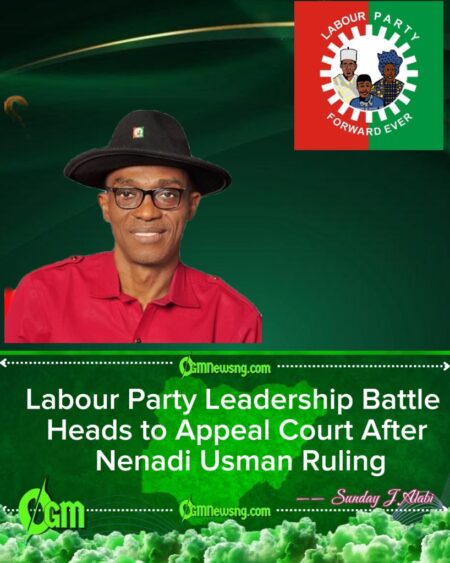
The internal leadership crisis within the Labour Party has taken a new legal turn following a judgment of the Federal High Court in Abuja recognising Senator Nenadi Usman as the party’s valid leader. The ruling, delivered on Wednesday by Justice Peter Lifu, has been strongly rejected by the Julius Abure-led faction of the Labour party, which has vowed to challenge the decision at the Court of Appeal. The development has further exposed deep divisions within the opposition party and raised renewed questions about judicial intervention in the internal affairs of political organisations in Nigeria.
Federal High Court Judgment and Its Legal Basis
Justice Peter Lifu of the Federal High Court, FCT, ruled that Senator Nenadi Usman is the valid leader of the Labour Party, relying largely on the April 4, 2025 judgment of the Supreme Court. In his decision, the judge recognised the Esther Nenadi Usman-led Caretaker Committee as the legitimate authority overseeing the affairs of the party.
The judgment effectively set aside the claims of the Julius Abure-led National Working Committee, which had previously been recognised by lower courts before the matter reached the Supreme Court. By anchoring his ruling on the apex court’s verdict, Justice Lifu held that the Caretaker Committee was validly constituted, thereby affirming Nenadi Usman’s leadership position.
The ruling has significant political implications, especially as the Labour Party continues to position itself as a major opposition force ahead of future electoral contests. However, the decision has also reignited debate over the extent to which courts can determine leadership structures within political parties.
Abure-Led Faction of Labour Party Rejects Verdict, Raises Red Flags
In a swift reaction, the Abure-led leadership of the Labour Party announced its intention to appeal the judgment, describing it as a contradiction of established judicial principles. In a statement issued in Abuja by the party’s National Publicity Secretary, Obiora Ifoh, the faction argued that the ruling violated the Supreme Court’s clear position that courts lack the power to appoint leaders for political parties.
According to Ifoh, the Supreme Court had consistently maintained that leadership disputes are internal matters beyond judicial interference. He expressed concern over the conduct of the case, citing what he described as “red flags,” including the reassignment of the matter from Justice Omotosho to Justice Peter Lifu and the court’s refusal to allow the Abure faction respond to issues raised in counter-affidavits before judgment was reserved.
The group also alleged that its opponents had celebrated the outcome prematurely on social media, suggesting foreknowledge of the judgment. Ifoh questioned what he described as a judicial “somersault,” noting that Nenadi Usman had previously argued before the Supreme Court that courts should not pronounce party chairmen, only for a Federal High Court to now do just that.
Tenure Dispute and Implications for Party Stability
The Abure-led faction of Labour party further disputed the court’s conclusion that there was a leadership vacuum within the party. It maintained that the tenure of the Labour party’s executive had not expired, stressing that a National Convention was validly held in March 2024, ahead of the June 2024 expiration date, to produce the current leadership.
Ifoh described as “laughable” the claim that a vacuum existed, arguing that the court failed to examine the legality and validity of the March 27, 2024 convention. He insisted that the Supreme Court never ruled that the Abure-led executive’s tenure had expired, but merely declined jurisdiction on the grounds that the matter was an internal party affair.
Despite the strong language, the Abure faction called on Labour party members to remain calm, assuring them that all legal steps would be taken to protect the party’s interests. The group also warned that the Labour Party was “not for sale,” insisting that no amount of financial influence would compel it to relinquish leadership outside the rule of law.
Table of Contents
Discover more from OGM News NG
Subscribe to get the latest posts sent to your email.