



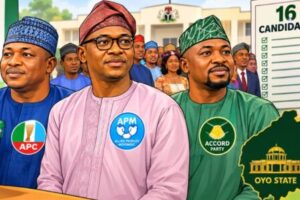






Democracy has again become the centre of Nigeria’s political debate after former Vice President Atiku Abubakar accused President Bola Tinubu’s administration of tolerating attempts to deregister opposition parties through the courts. The accusation, delivered with unusual bluntness, has reignited fears that the country’s hard-earned multi-party system could be facing one of its biggest tests since the return to civilian rule.
Atiku’s remarks followed fresh litigation concerning the Nigeria Democratic Congress, NDC, and came only days after a Federal High Court ordered the deregistration of the African Democratic Congress and four other parties over their electoral performance. The developments have generated widespread debate about whether Nigeria is witnessing the enforcement of constitutional provisions or the gradual narrowing of political competition.
Atiku Says Jonathan and Buhari Never Shut Out Opposition Voices
According to Atiku, former presidents Goodluck Jonathan and Muhammadu Buhari governed the country without attempting to remove opposition parties from the political landscape, despite facing strong challengers and periods of intense political rivalry. He argued that any administration confident in its popularity and achievements should not be afraid of a free and fair contest.
Atiku further warned that restricting political competition could weaken public confidence in the electoral process and create the impression that democracy is being managed to favour only a select group. Opposition figures and supporters have increasingly used the phrase “one-party state” to describe their concerns, insisting that democracy depends on the survival of competing political platforms and diverse voices.
Court Battles Over Political Parties Spark Fresh Democracy Concerns
The controversy comes against the backdrop of recent court decisions ordering the deregistration of several opposition parties, including the African Democratic Congress, on the grounds that they allegedly failed to satisfy constitutional electoral thresholds. The affected parties have rejected the rulings and vowed to pursue appeals through all available legal channels. Reports indicate that appellate proceedings have already complicated the implementation of some of the judgments and may ultimately determine the future of the parties involved.
Political analysts note that Nigeria’s Constitution contains provisions allowing the deregistration of parties that fail to meet certain requirements, creating a complicated debate between legal compliance and democratic inclusion. Some observers argue that enforcing the law could reduce the number of inactive parties on the ballot, while critics insist that aggressive deregistration efforts, particularly close to a major election cycle, risk creating perceptions of political intimidation. The issue has also exposed deeper divisions within Nigeria’s opposition movements as they struggle to unite ahead of the 2027 elections and confront the advantage of incumbency. Recent political realignments and court disputes have further intensified anxieties about the health of the country’s democratic system.
As the legal and political drama unfolds, democracy and deregistration are likely to remain defining issues in Nigeria’s march toward the next general election. Whether these courtroom battles strengthen constitutional order or deepen public suspicion of the political process may ultimately shape not only the fate of individual parties but also public confidence in Nigeria’s democratic future. OGM News Nigeria will continue to monitor developments as the story evolves.
Table of Contents
Discover more from OGM News NG
Subscribe to get the latest posts sent to your email.