








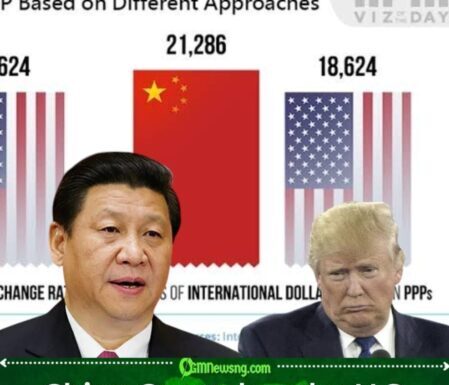
China has once again become the focal point of the global economic conversation after maintaining its lead over the United States in GDP (PPP), a measurement that compares economies by adjusting for differences in purchasing power rather than market exchange rates. While some have rushed to declare the contest over, economists continue to argue that the answer depends on which economic yardstick is being used. The figures have reignited debates about global influence, productivity, and whether the world’s economic scoreboard has become more complicated than ever before.
China’s Economic Milestone Sparks Fresh Questions About Global Power
China’s position at the top of GDP measured by Purchasing Power Parity reflects the enormous scale of its domestic economy and manufacturing sector. Under the PPP method, goods and services are valued according to what they can actually purchase within each country instead of being converted solely through international currency exchange rates. Because many products and services remain less expensive in China than in the United States, China’s overall economic output appears larger under this internationally recognized measurement. For supporters, the ranking demonstrates how decades of industrial expansion, infrastructure development, and rising productivity have transformed China into an economic powerhouse whose influence extends far beyond its borders.
China’s achievement, however, has also become a reminder that economic statistics rarely tell a complete story on their own. The United States continues to lead the world in nominal GDP, hosts the deepest financial markets, attracts enormous global investment, and benefits from the continued dominance of the U.S. dollar in international trade and finance. In other words, while China may celebrate one economic trophy, America is still holding several others. The friendly rivalry has even inspired light-hearted jokes among analysts, with some quipping that one nation arrived carrying a larger calculator while the other arrived carrying a stronger currency.
The World’s Biggest Economy Depends on Which Numbers You Trust
The debate surrounding GDP (PPP) highlights a broader lesson about interpreting economic data. Purchasing Power Parity is widely used by international organizations when comparing living costs and production across countries because it removes many distortions caused by fluctuating exchange rates. Nominal GDP, by contrast, remains the preferred measure for evaluating financial power, international borrowing capacity, and the size of economies in global markets. Neither indicator is inherently wrong; each answers a different economic question. Confusion begins only when one is presented as replacing the other rather than complementing it.
China now faces fresh challenges that will determine whether it can sustain its economic momentum in the coming years. Slower domestic growth, demographic changes, property market pressures, and increasing competition in advanced technology continue to test policymakers. Meanwhile, the United States is investing heavily in manufacturing, artificial intelligence, semiconductor production, and strategic industries while seeking to strengthen supply chains and maintain technological leadership. Rather than witnessing the conclusion of an economic race, the world may simply be watching the beginning of a new phase in a competition that is evolving faster than the headlines themselves.
As global markets continue to react to shifting economic trends, China and GDP (PPP) will remain central to discussions about international influence and long-term growth. OGM News Nigeria will continue monitoring developments, because in the contest for economic leadership, today’s headline rarely becomes tomorrow’s final verdict.
Table of Contents
Discover more from OGM News NG
Subscribe to get the latest posts sent to your email.